
Greenhouse operations are more complex than ever. Managing climate, water, light and growing media across a commercial facility demands precision that manual methods can’t reliably deliver. Integrating technology for effective greenhouse management has become the defining factor separating high-yield operations from underperforming ones.
Introduction
Modern greenhouse production runs on data. Sensors track temperature, humidity and CO2 in real time. Automated systems respond faster than any human operator can. The result is a more consistent growing environment and more predictable crop performance.
For professional growers managing peat-based and bark-based growing media, substrate performance is only part of the equation. The environment surrounding that media matters just as much. Getting climate, irrigation and light right requires systems that work together, not in isolation.
The stakes are real. Operations that invest in integrated technology report measurable gains in yield, energy efficiency and resource use. Those that don’t face rising input costs and growing competitive pressure.
What Greenhouse Technology Integration Actually Means
Technology integration isn’t about adding one sensor or one software tool. It’s about connecting climate control, irrigation, lighting, monitoring and data systems into a unified platform that responds to crop needs automatically.
The global smart greenhouse market reflects this shift. According to Fortune Business Insights, the market was valued at USD 6.77 billion in 2025 and is projected to reach USD 27.17 billion by 2034. A peer-reviewed 2025 study published in Nature Scientific Reports found that smart technology adoption exerts the strongest direct influence on optimal greenhouse management outcomes.
A fully integrated system typically includes:
- IoT sensors: Continuous monitoring of temperature, humidity, CO2 and light levels
- Automated controllers: Real-time adjustments to HVAC, irrigation and lighting without manual input
- Data management software: Centralized dashboards that log, analyze and surface specific crop insights
- Predictive analytics: AI-driven tools that anticipate crop needs before problems develop
Core Climate Control Systems Every Grower Needs
Climate control is the foundation of any integrated greenhouse operation. According to InsightAce Analytic, the greenhouse climate control systems market is valued at USD 2.83 billion in 2025, and climate control technology holds the largest IoT greenhouse share at 41.2% of total revenues.
Temperature and Humidity Control
Maintaining precise temperature and humidity is critical for consistent crop performance. Fully automated smart greenhouses now hold nearly 46% of the global greenhouse market share, according to Market.us. AI-driven IoT platforms deployed across 30 or more commercial facilities have achieved HVAC energy savings of 30 to 38% and a 68 to 73% reduction in vapor pressure deficit variability, according to an arXiv preprint. For growers using peat-based growing media, stable vapor pressure deficit directly supports consistent moisture retention and root zone performance.
Greenhouse Lighting and CO2 Management
Light and CO2 management work together to drive photosynthesis and crop development. Reinforcement learning climate control systems have demonstrated 25.93% total energy savings compared to fixed set-point control, with cooling process savings reaching up to 45%, according to ScienceDirect. AI-powered systems also reduced critical equipment alarms by 75 to 80% through predictive anomaly detection. Maintaining CO2 within the 800 to 1,200 ppm range supports optimal photosynthesis across most commercial crops.
“Smart technology adoption exerts the strongest direct influence on optimal greenhouse management outcomes.” – Nature Scientific Reports
Strategic Advantages of Data-Driven Horticulture
Data-driven horticulture gives professional growers the visibility to make better decisions faster. The greenhouse management software market reflects this value, sized at $1.68 billion in 2025 and forecast to reach $4.82 billion by 2030, representing a 23.47% CAGR, according to Marqstats.
Energy and Resource Efficiency
Smart greenhouses reduce total operational costs by 30 to 45% compared to traditional greenhouses, and facilities deploying advanced technology have achieved a 30% ROI improvement in just 18 months, according to KY Greenhouse. Energy savings of this scale directly offset the cost of premium growing media inputs, making the overall production model more financially sustainable. Growers who pair efficient climate systems with science-driven substrates gain compounding performance benefits.
Crop Monitoring and Yield Consistency
Real-time crop monitoring closes the gap between what growers observe and what’s actually happening at the root zone. Great Lakes Greenhouses, a leading commercial cucumber producer, deployed AI technology and achieved a 19.6% increase in cucumber yield while improving energy efficiency by 17%, according to Gothic Arch Greenhouses. Consistent environmental control also reduces the variability that undermines growing media performance, ensuring that peat-based substrates deliver the air porosity and water retention they’re engineered to provide.
Irrigation and Water Management Technology
Water management is one of the highest-leverage areas for technology integration. Sensor-based irrigation systems captured 56% of smart irrigation market revenue in 2024 and are projected to expand at a 19.8% CAGR through 2030, according to MarketsandMarkets.
Drip, Ebb-and-Flow, and Recirculating Systems
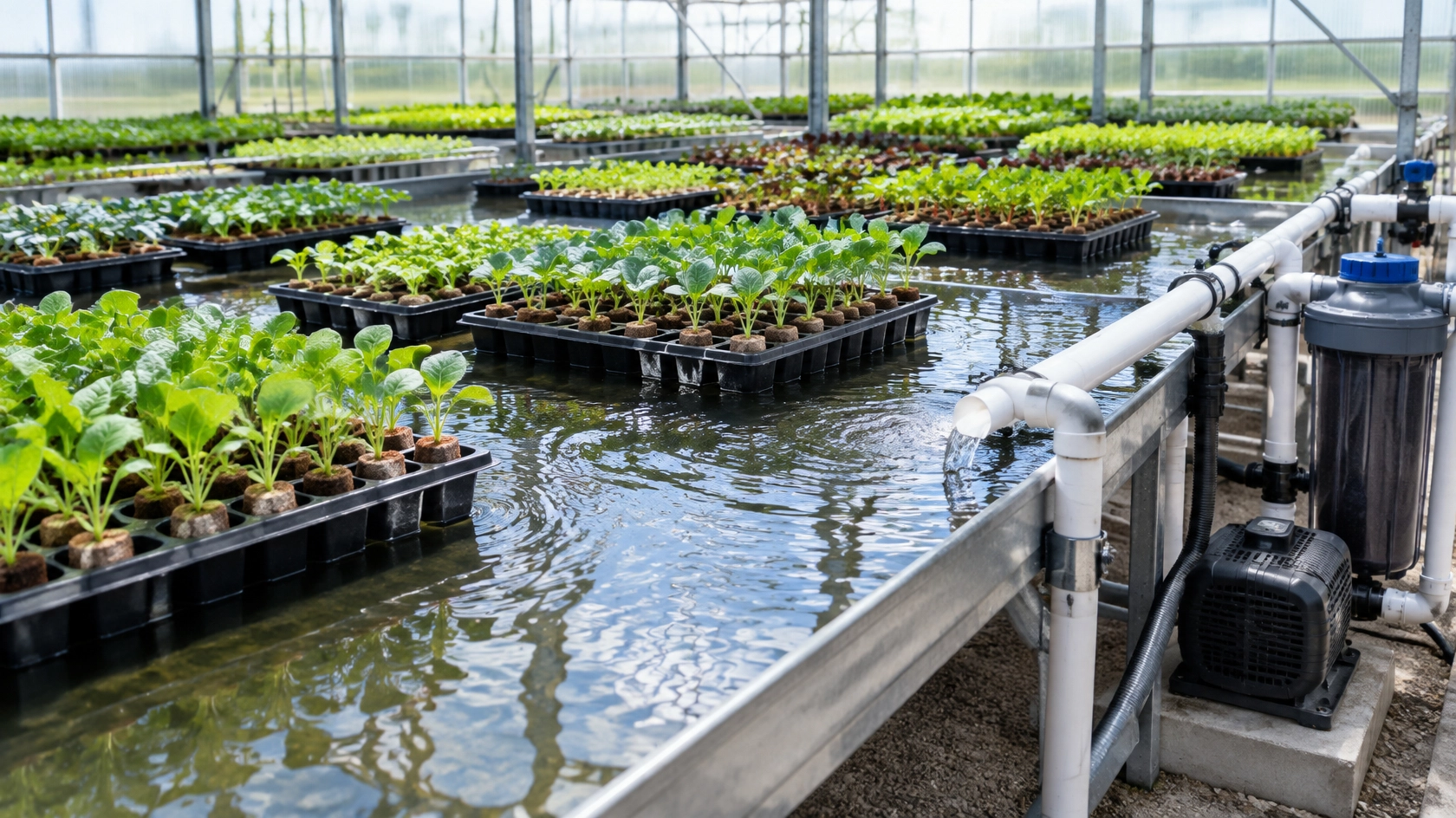
Each irrigation method carries distinct advantages depending on crop type and facility design. Drip irrigation technology held the leading 39.2% share of the greenhouse irrigation market in 2025, with Netafim’s IoT-enabled drip systems improving water efficiency by up to 50% through real-time soil moisture sensors and cloud-based scheduling, according to HashStudioz. Recirculating hydroponic systems reduce irrigation water use by more than 50% while also cutting fertilizer consumption by 30 to 40%, according to NCBI/PMC. These systems pair well with structured growing media that maintain consistent drainage and rewetting characteristics.
Water Reuse and Sustainability Goals
Closed-loop water systems are becoming standard practice in high-performance greenhouse operations. A peer-reviewed study found that an IoT-equipped greenhouse achieved water use reductions of 41%, greenhouse gas emissions reductions of 38% and fertilizer input reductions of 91%, according to ScienceDirect. Controlled-environment agriculture systems can reduce water consumption by 53 to 98% compared with open-field farming. For growers committed to responsible resource use, water recirculation technology aligns directly with broader sustainability goals across the supply chain.
“IoT-equipped greenhouses achieved water use reductions of 41%, greenhouse gas emissions reductions of 38% and fertilizer input reductions of 91%.” – ScienceDirect
Overcoming Common Integration Challenges
Adoption barriers are real, but they’re not insurmountable. A 2025 Nature Scientific Reports study found that approximately 65% of greenhouses lacked automation and 25% had only low-to-moderate automation levels.
The most common challenges include:
- Upfront capital costs: Smart control systems typically represent only 5 to 12% of total greenhouse investment, yet payback periods run 1.5 to 3 years for glass structures and 3 to 5 years for plastic film, according to PolyGreenhouse
- Regulatory and licensing complexity: The Resource Innovation Institute identified multi-state contractor licensing costs exceeding $100,000 as a significant U.S.-specific barrier
- Skills gaps and labor turnover: U.S. greenhouse workers average only 1 to 2 years of tenure, creating chronic knowledge gaps that slow technology adoption
- Technology underutilization: The Resource Innovation Institute notes the U.S. significantly underutilizes AI-enhanced environmental controls and LED spectrum management that are standard practice in Western Europe and Canada
“The U.S. significantly underutilizes AI-enhanced environmental controls and LED spectrum management that are standard practice in Western Europe and Canada.” – Resource Innovation Institute
Conclusion
Integrating technology for effective greenhouse management is no longer a competitive advantage reserved for large operations. Sensors, automated climate systems, data-driven irrigation and crop monitoring software are accessible tools that deliver measurable returns across facilities of all sizes. The growers who act on this shift gain more consistent crop performance and stronger control over input costs.
The growing media a grower selects still matters enormously. But technology ensures that substrate performs as intended, every cycle. Professional growers who combine science-driven growing media with integrated management systems are best positioned to meet the demands of today’s horticulture.
Frequently Asked Questions
How much does smart greenhouse technology cost in the United States?
A fully integrated commercial system costs $15 to $35 per square meter for IoT instrumentation alone. Smart control systems typically represent only 5 to 12% of total greenhouse investment. U.S. operators face additional costs from multi-state licensing and utility demand charges that can reach $80,000 to $100,000 per month, according to the Resource Innovation Institute. Despite these barriers, most operators recover IoT investment costs within 2 to 4 years through combined energy, water and labor savings.
How does greenhouse technology adoption compare across the United States versus other regions?
The United States significantly underutilizes AI-enhanced environmental controls and LED spectrum management compared to Western Europe and Canada, according to the Resource Innovation Institute. Cooperative Extension services can no longer conduct basic research on high-tech greenhouse technologies due to changed funding landscapes. The U.S. did document an 18% uptick in controlled-environment acreage from 2022 to 2025, according to USDA data, suggesting adoption is accelerating despite structural barriers.
What is a digital twin in greenhouse management?
A Predictive Greenhouse Digital Twin creates a real-time virtual replica of a greenhouse using an IoT sensor network. Using LSTM modeling, one study achieved an R2 of 0.986 in yield prediction accuracy, according to ResearchGate. Currently, 73% of greenhouse digital twin implementations focus on monitoring, while 18% include predictive capabilities such as growth simulation. Digital twins allow growers to test environmental adjustments virtually before applying them to live crops.
How does smart greenhouse technology compare to traditional greenhouse management?
Traditional greenhouses rely on manual monitoring and reactive adjustments. Smart systems replace that with continuous sensor data and automated responses. According to Gothic Arch Greenhouses, 70% of farmers using AI reported a 20% increase in operational efficiency and crop yields. AI-powered systems also reduced critical equipment downtime by 74% through predictive anomaly detection, a capability that manual management simply cannot replicate at scale.
How long does it take to implement an integrated greenhouse management system?
Implementation timelines vary by facility size and existing infrastructure. Commercial greenhouse operators typically recover IoT investment costs within 2 to 4 years, with energy savings of 15 to 30%, water savings of 30 to 50% and labor cost reductions of 20 to 40%, according to PolyGreenhouse. Cloud adoption among new greenhouse management software deployments exceeded 78% in 2025, making initial setup faster than legacy on-premise installations. Growers typically start with climate monitoring before expanding to full automation.