
Most growers don’t lose plants to bad luck. They lose them to repeatable, fixable mistakes. Research shows that 78.4% of houseplant deaths are entirely preventable with existing care knowledge. Knowing the top 7 mistakes that hinder plant growth, and the ones beyond that list, gives every grower a real advantage.
Introduction
Plant loss is frustrating, but it’s rarely mysterious. The same errors show up season after season, whether you’re managing a commercial greenhouse or a home growing setup. Understanding what actually goes wrong, and why, is the first step toward consistent results.
Professional growers know that growing media, watering habits, pH management and environmental controls all interact. A mistake in one area compounds problems in another. Getting these fundamentals right protects your investment and your crop.
The data behind plant failure is clearer than ever in 2026. Evidence-based growing practices are no longer reserved for large operations. Growers at every scale can apply the same science-driven principles that professional horticulturists rely on.
What Actually Stunts a Plant’s Growth
Plant decline rarely comes from a single cause. According to Plant Grail’s 2026 houseplant mortality analysis, water-related issues alone account for 14.9% of all plant deaths, making them the single largest preventable category. Environmental stresses including nutrient deficiency, temperature extremes and water stress collectively reduce plant growth and crop yield by approximately 22% worldwide.
The most common growth-limiting factors include:
Water mismanagement: Overwatering and root rot are the leading causes of preventable plant death
Light mismatch: Insufficient or excessive light disrupts photosynthesis and energy production
Poor growing media: Wrong substrate choice restricts root development from day one
pH imbalance: Nutrient lockout occurs even when fertilizer is applied correctly
Nutrient errors: Both overfeeding and underfeeding cause measurable yield losses
Environmental stress: Temperature swings and humidity extremes suppress growth at the cellular level
Mistake 1: Starting With the Wrong Growing Media
Choosing the wrong growing media is one of the most common, and most costly, errors a grower can make. According to Growli’s 2026 Wrong-Soil Report, up to 80% of container gardening failures are linked to poor substrate selection. A 2026 analysis of more than 10,000 catalogued plant species found that 77% need free-draining growing media and 35% require a specialist mix, not standard bagged compost.
Choosing the Right Mix for Your Crop
Different crops have different substrate requirements. Vegetables, flowering annuals and woody perennials all behave differently in the root zone. Professional horticulturists match growing media to crop type, drainage needs and production system. Sun Gro® Horticulture develops science-driven growing media, including peat moss and peat-based blends, specifically formulated to meet these varied requirements across commercial and retail growing environments.
Common Growing Media Mistakes and Fixes
Using a single generic mix across all crops is a reliable path to inconsistent results. Heavy mixes compact over time, restricting oxygen to roots. Mixes without adequate perlite or drainage amendments hold excess moisture. According to Sun Gro Horticulture, spending more on quality growing media can raise the likelihood of plant success by as much as 40%.
When to Refresh or Replace Your Media
Growing media degrades over time. Peat moss breaks down, perlite migrates and pH shifts as salts accumulate. For container crops, refreshing or replacing media between production cycles prevents carryover disease and maintains consistent drainage. Professional growers track media age and performance as part of routine crop management, not as an afterthought.
Mistake 2: Overwatering or Underwatering
Watering errors are the leading cause of plant failure across growing environments. 67% of all “dying plant” cases trace back to too much water, not too little. Both extremes cause serious damage, but overwatering is more common and often harder to diagnose early.
Effects of Inconsistent Watering on Plant Health
Inconsistent watering stresses plants at the cellular level. According to Growli’s 2026 Overwatering Report, by the time yellow leaves appear at the top of a plant, 40-60% of the root system may already be dead. Underwatering causes irreversible cellular damage well before visible wilting, and repeated dry cycles can cut new leaf area by 15-30%.
Best Practices: Drip Systems and Moisture Meters
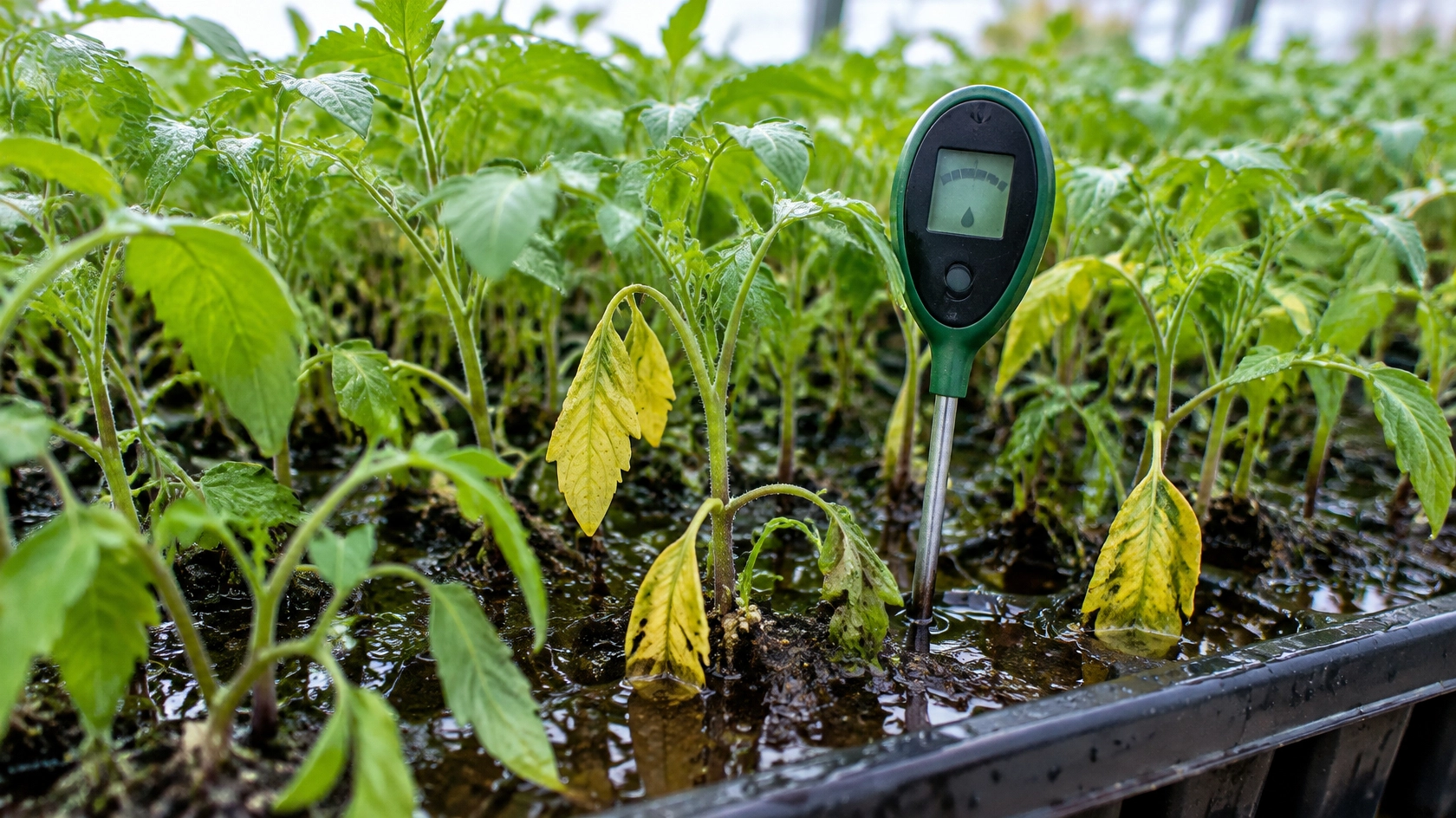
Drip irrigation and moisture meters remove the guesswork from watering decisions. Drip systems deliver water directly to the root zone at controlled rates, reducing both overwatering risk and foliar disease pressure. Moisture meters give growers an objective reading of substrate saturation rather than relying on visual assessment, which fails far more often than most growers expect.
Establishing a Watering Routine
A consistent watering routine, built around crop type, container size and environmental conditions, prevents the swings that stress plants most. Professional growers track substrate moisture, drainage volume and watering frequency as part of daily crop monitoring. Zucchini and other fast-growing crops are especially sensitive to moisture fluctuations during fruit set.
Mistake 3: Skipping pH Checks
pH is the most important soil factor for plant growth, directly controlling nutrient availability, microbial activity and enzyme function. According to ResearchGate, even modest pH shifts dramatically cut fertilizer efficiency. Research shows that potassium availability has an R² of 0.712 with soil pH, meaning pH controls how much of your applied fertilizer actually reaches the plant.
Key facts growers should know:
37% of arable soils sampled by PAAG fall below the optimum pH of 6.5-7, per PDA data
Nitrogen and phosphorus availability drop sharply outside the optimal pH window
Eggplant research found total nitrogen content was 263-322% higher at pH 7.0-7.5 than at pH 4.5, per PMC/NCBI
Regular testing with a calibrated meter prevents nutrient lockout even when fertilizer rates are correct
Mistake 4: Overfeeding or Underfeeding Nutrients
Fertilizer misuse is cited as the second-leading cause of houseplant death in North America, accounting for over 37% of diagnostic cases brought to university extension hotlines annually, according to Atami. Getting nutrition right requires understanding both deficiency signs and growth-stage timing.
Reading Nutrient Deficiency Signs
Deficiency symptoms appear on different parts of the plant depending on which nutrient is lacking. Mobile nutrients like nitrogen show symptoms on older leaves first. Immobile nutrients like calcium show symptoms on new growth. Zinc deficiency alone can cause yield losses exceeding 40% in affected crops, often without obvious visual symptoms until damage is severe.
Feeding Schedules That Match Growth Stage
Nutrient demand changes throughout a crop’s life cycle. Seedlings need lower fertilizer concentrations than established plants in active vegetative growth. Flowering and fruiting stages often require adjusted phosphorus and potassium ratios. A feeding schedule built around growth stage, not calendar date, prevents both salt buildup from overfeeding and the hidden losses that come from underfeeding during critical windows.
Mistake 5: Overcrowding Plants
Overcrowding is a yield problem that compounds over time. Overcrowded hydroponic leafy greens can yield up to 30-40% less biomass per plant compared to properly spaced crops grown under identical conditions. Dense planting also increases susceptibility to lodging, pest pressure and disease spread.
Spacing errors affect every part of production:
Light competition: Canopy overlap reduces photosynthesis in lower leaves
Airflow restriction: Dense plantings trap humidity and create disease-favorable microclimates
Root competition: Overlapping root zones deplete moisture and nutrients before crop maturity
Pest spread: Physical contact between plants accelerates pest movement through a crop
Mistake 6: Ignoring Temperature and Humidity
Temperature and humidity affect plant growth at every stage, from germination through harvest. According to ResearchGate, for every 1 degree Celsius rise in temperature, grain yield drops by 8-10%. Getting environmental controls right is not optional for consistent production.
Impact of High Humidity on Mold, Pests, and Plants
High relative humidity creates ideal conditions for fungal pathogens and soft-bodied pests. A 2025 Frontiers in Plant Science study found that relative humidity in the 78-98% range delayed flowering by three weeks and suppressed floral development by 14.3-25.6% in test crops. Botrytis, powdery mildew and spider mites all thrive when humidity is unmanaged.
Temperature Ranges for Different Growth Stages
Most vegetable and flowering crops perform best between 65 and 80 degrees Fahrenheit during the day, with a slight drop at night to support carbohydrate accumulation. Seedlings tolerate less temperature variation than established plants. During the reproductive stage, temperature extremes are especially damaging. Research from FAO found that extreme heat during maize reproduction reduced grain yield by 80-90% compared to normal temperature regimes.
Mistake 7: Neglecting Root Health and Oxygenation
Root zone oxygenation is one of the most overlooked factors in growing media management. A 2025 study published in Plant Physiology and Biochemistry found that oxygenation increased root length by 76.3% at a soil bulk density of 1.5 g/cm³ compared to non-oxygenated controls. Compacted or waterlogged growing media starves roots of oxygen, slowing growth even when nutrition and watering appear correct.
Peat moss-based growing media, when properly formulated with perlite and other drainage amendments, supports the pore structure that keeps oxygen available to roots. Professional growers monitor substrate bulk density and drainage rates as indicators of root zone health, not just surface appearance.
Mistake 8: Planting Everything at Once
Timing matters as much as technique. Visual soil assessment fails 92% of the time, meaning growers who judge planting readiness by sight rather than soil temperature or testing consistently plant in conditions that stunt root development.
Planting everything at once also creates harvest management problems. A single large planting of lettuce matures all at once in 4-6 weeks, per Boots and Hooves Homestead. Succession planting every 2-3 weeks prevents gluts and gaps in harvest, a practice that professional growers treat as standard production planning.
Mistake 9: Ignoring Pest and Disease Pressure
Pest and disease pressure reduces yields before most growers notice a problem. In the 2026 Plant Grail mortality dataset, 78% of pest fatalities involved two or more weeks of visible symptoms before treatment began. Early intervention is the difference between a manageable outbreak and a lost crop.
Common warning signs growers should monitor:
Leaf discoloration: Yellowing, spotting or bronzing often signals pest feeding or fungal infection
Distorted new growth: Aphids, thrips and broad mites cause characteristic distortion on emerging leaves
Stem lesions: Cankers and collar rot indicate fungal or bacterial disease at the root crown
Sticky residue: Honeydew from sucking insects signals active infestation before visible damage appears
Mistake 10: Choosing Incompatible Plants or Varieties
Plant compatibility affects yield even when individual care is correct. Allelopathic interference, where one plant’s chemical compounds suppress neighboring plants, can reduce neighboring plant biomass by up to 30-45% depending on species pairing, according to ResearchGate. Strategic companion planting, by contrast, can enhance garden yields by 20-30%.
Compatibility considerations for growers include:
Allelopathic species: Some crops release compounds that suppress neighbors, even desirable ones
Root depth competition: Shallow and deep-rooted crops can share space; same-depth crops compete directly
Nutrient demand overlap: High-nitrogen crops planted together deplete the root zone faster
Disease host range: Grouping crops from the same family increases shared disease vulnerability
Mistake 11: Overlooking Ventilation and Airflow
Airflow is a growth input, not just a comfort factor. According to CANNA Gardening, a drop of just 25% in natural CO₂ concentrations can inhibit indoor plant growth by over 50%. Indoor grow rooms should undergo a complete air change every 15 minutes to maintain adequate CO₂ levels.
Ventilation best practices for professional growing environments:
Air exchange rate: Complete air changes every 15 minutes prevent CO₂ depletion in enclosed spaces
Gentle circulation: High wind speed decreases plant growth; gentle airflow is the target
Humidity control: Active ventilation removes excess moisture, reducing mold and disease pressure
CO₂ monitoring: Sensors allow growers to detect depletion before it affects photosynthesis rates
Conclusion
Plant growth problems are rarely random. They trace back to specific, correctable decisions about growing media, water management, nutrition, environmental control and crop planning. Growers who address these areas systematically see measurable improvements in consistency and yield.
The science behind plant health is well established. Professional horticulturists have long relied on evidence-based practices to reduce loss and improve production outcomes. Applying those same principles, starting with quality growing media and sound environmental management, gives every grower a stronger foundation for success.
Frequently Asked Questions
What is the most common mistake that kills plants in the United States?
Overwatering is the leading cause of plant death for home and professional growers across the United States. According to a Greg App survey, 54% of plant owners name overwatering as their biggest unintentional plant killer. Roots sitting in saturated growing media develop anaerobic conditions quickly, and visible above-ground symptoms often don’t appear until significant root damage has already occurred.
How does growing media quality affect plant success rates?
High-quality growing media produces 10.3% higher mean crop yields and decreases yield variability by 15.6% compared to lower-quality substrates, according to ResearchGate research published in 2025. Sun Gro® Horticulture, North America’s largest producer of horticultural-grade peat, formulates peat moss-based growing mixes specifically to support consistent drainage, aeration and root development across a wide range of crops and production systems.
Can touching plants too much stunt their growth?
Yes. Research shows that within 30 minutes of being touched, 10% of a plant’s genetic makeup is altered as the plant diverts energy to a stress response, per PMC research. Repeated physical contact can reduce plant growth by up to 30%. In wound studies, repeated physical treatment stunted growth by 50% and increased the growth inhibitor jasmonate seven-fold. Handling plants only when necessary supports uninterrupted growth.
How does pH affect nutrient availability compared to fertilizer rate?
pH has a stronger influence on nutrient uptake than fertilizer application rate in many cases. Studies show potassium availability correlates with soil pH at R² = 0.712, meaning pH explains most of the variation in potassium uptake. Applying more fertilizer to a pH-imbalanced substrate wastes inputs and can worsen salt stress. Testing and correcting pH before adjusting fertilizer rates is the more effective sequence for professional growers.
How quickly can overwatering damage a plant’s root system?
Roots sitting in pooled water begin developing anaerobic conditions within 48 hours, initiating the early stages of root rot. Most growers don’t see visible above-ground symptoms until 40-60% of the root system is already compromised, according to Growli’s 2026 Overwatering Report. Using growing media with adequate drainage, combined with containers that have drainage holes, significantly reduces overwatering risk before it becomes a recovery problem.