
Choosing the wrong growing media can cost a professional grower an entire crop cycle. Peat-based vs bark-based professional growing mixes perform very differently across crops, climates and production systems. Understanding those differences is what separates consistent results from costly guesswork.
Introduction
Professional growers face a real decision every season: build a program around peat moss, bark or a blend of both. Each base ingredient brings distinct physical properties, cost structures and crop suitability profiles that directly affect plant performance.
The debate has sharpened in recent years. Regulatory pressure in Europe and growing sustainability awareness in the United States are pushing growers to evaluate alternatives more seriously than ever before.
Getting the substrate selection right matters at every scale. A mismatch between media and crop can affect water management, pH stability, nitrogen availability and ultimately, the bottom line.
What Peat-Based Growing Mixes Are
Peat-based growing mixes use Canadian sphagnum peat moss as their primary ingredient. Peat delivers a unique combination of properties that no current alternative fully replicates.
Key characteristics include:
Water retention:Sphagnum peat moss holds at least 15 to 20 times its own weight in water.
Total porosity: Peat reaches 89 to 94% total porosity with water holding capacity of 74 to 77% by volume, per the LSU AgCenter
Natural pH: Ranges from 3.0 to 5.0, requiring lime amendment before use
Nitrogen neutrality: Peat contains less than 1% nitrogen and does not immobilize it, unlike bark
Structural stability: Peat maintains consistent physical properties across a full production cycle
What Bark-Based Growing Mixes Are
Bark-based growing mixes rely on processed pine or fir bark as their primary component. Pine bark dominates in the eastern United States; Douglas fir bark is standard on the West Coast.
Core properties of bark media include:
Air space: Bark provides 19 to 24% air space by volume, giving it a clear aeration advantage over peat
pH range: Processed bark runs 4.5 to 6.5, requiring less lime than peat
Water holding: Lower than peat at approximately 56% by volume, per the LSU AgCenter
Nitrogen draw: Bark immobilizes nitrogen through microbial activity, requiring supplemental pre-plant feeding
Decomposition resistance: Pine bark resists breakdown and contains fewer leachable organic acids than hardwood bark, which breaks down three times more quickly, according to University of Arkansas Cooperative Extension
Why Peat Moss Is Losing Favor
Peat moss built professional horticulture. But its environmental footprint has drawn serious scrutiny from regulators, retailers and growers alike.
Environmental Concerns Driving the Shift
Peatlands store more than 600 gigatonnes of carbon globally, representing up to 44% of all soil carbon, according to Oregon State University Extension citing IUCN data. Degraded peatlands contribute 4 to 10% of annual global anthropogenic CO2 emissions. Extracting peat releases approximately 6,000 tons of CO2 per acre each year, and it takes wetlands 1,000 years to form just three feet of peat, making it functionally non-renewable.
In response, 18 countries enacted peat extraction limits in 2025. European restrictions across 15 countries reduced peat volume by 18%, and more than 200 commercially available peat-free formulations are now marketed in Europe alone, per IndexBox Market Intelligence.
Why Peat Is Still Used Despite the Criticism
Full replacement remains difficult. A 2025 review published in Frontiers in Horticulture confirmed that peat offers “a unique combination of nutrient control, pH buffering, water retention, absence of harmful microorganisms, and structural stability” that no current alternative fully matches, per ResearchGate.
“UK professional growers reduced peat use to 21.8% of their growing media in 2025, down from 39.5% in 2023, confirming that peat remains embedded in professional production systems.” – The Dirt
Peat vs Bark: Key Physical Differences
The physical gap between peat and bark shapes every management decision a grower makes, from irrigation scheduling to fertilizer programs.
Water Retention and Drainage
Peat provides 250 to 400 mL of plant-available water per liter of substrate, a range that no current peat substitute has matched, according to Frontiers in Horticulture.
Bark holds far less moisture but drains faster. This makes bark well suited to crops that are sensitive to overwatering. A 2025 Royal Society study using X-ray computed tomography confirmed that peat had considerably larger average pore sizes and greater initial gravimetric moisture content than bark-based alternatives, per Royal Society Interface.
pH and Nutrient Availability
Peat buffers pH at 23 meq/L compared to 15 meq/L for bark, making peat-based mixes far more resistant to pH swings from fertilization or irrigation, per Clemson University HGIC.
“Composted pine bark requires 0.2 to 0.5 g/L of supplemental nitrogen pre-planting; aged pine bark requires 0.4 to 0.8 g/L. Peat does not immobilize nitrogen at all, giving it a clear advantage in programs where precise fertilization control matters.” – University of Arkansas Cooperative Extension
Which Mix Fits Which Crop
Crop type is the most reliable guide to media selection. Neither peat nor bark is universally superior.
Matching media to crop requirements:
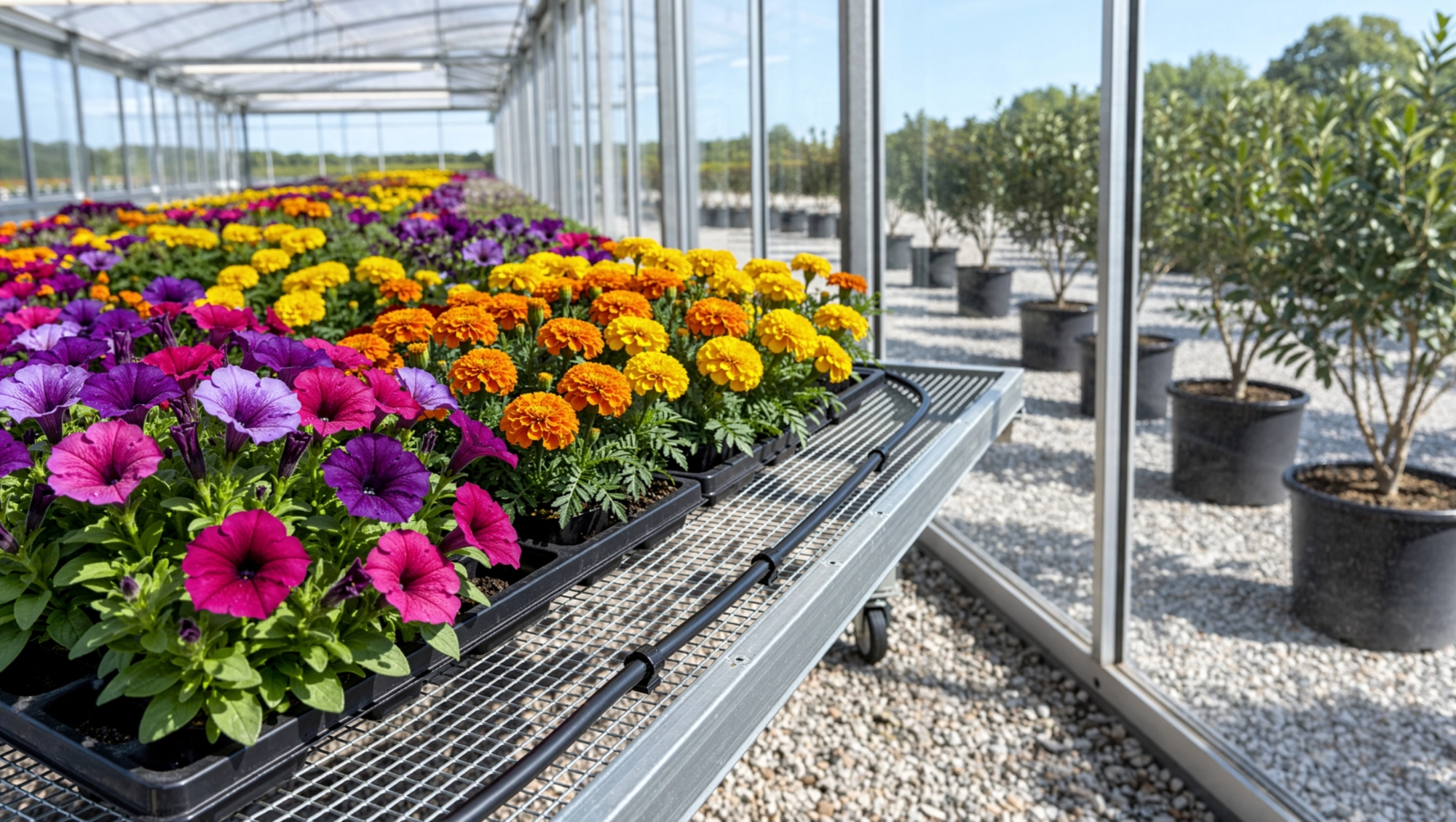
Greenhouse annuals and bedding plants: Peat-based mixes dominate, with most commercial formulations containing 30 to 60% peat moss, per Grower Talks
Nursery and woody container crops: Bark is the standard, comprising up to 75 to 100% of container substrates in the eastern United States, per USDA ARS
Orchids: Grow well in 100% pine bark or pine bark blended with sphagnum moss and perlite for maximum aeration
Garden mums and outdoor perennials: Bark-based media suits these crops due to low water retention, good drainage and high bulk density
Leafy greens and vegetables: A substrate of 75% peat with 25% fine coir produced the greatest biomass for arugula and lettuce across three growing seasons, per MDPI Plants Journal
Woody ornamentals: Bark mixes produced more than 53.9% higher biomass than peat for Viburnum tinus, while Leptospermum scoparium ‘Martinii’ produced more than 18.8% more biomass in peat, per MDPI Sustainability, confirming that crop-by-crop evaluation is essential
Cost and Availability of Each Mix in the US
Cost and supply chain logistics differ significantly between peat and bark in the United States.
Key pricing and availability factors:
Peat supply chain: Most U.S. peat is imported from Canada, making it subject to international shipping costs and currency fluctuations; the North American peat market was valued at USD 666.97 million in 2025, per Maximize Market Research
Bark supply chain: Pine bark and compost are generally sourced locally across the U.S.; the South accounts for 40% of U.S. timberland, ensuring robust domestic supply
Cost differential: A 2025 German study found bark costs approximately 12% more per cubic metre than peat, though this gap is smaller in the U.S. due to domestic availability, per MDPI Sustainability
Peat-free premium: Growers transitioning away from peat report fully peat-free growing media costs around 10% more overall, with individual operations reporting increases of 5 to 15%, per Greenhouse Grower
Bark market growth: The global bark-based growing media market is projected to grow at a CAGR of 4.6% from 2026 to 2035, driven by regulatory pressure eliminating peat in EU and UK markets, per IndexBox Market Intelligence
“Peatlands store more than 600 gigatonnes of carbon globally, representing up to 44% of all soil carbon. Extracting peat releases approximately 6,000 tons of CO2 per acre each year.” – Oregon State University Extension
Conclusion
Peat-based and bark-based professional growing mixes each serve a distinct role in commercial horticulture. Peat delivers unmatched water retention, pH buffering and structural consistency. Bark offers superior aeration, local availability and long-term container stability.
The strongest programs often combine both. Growers who match media properties to crop requirements, irrigation systems and production timelines consistently achieve better results than those who default to one base ingredient. Contact your Sun Gro® representative to find the right mix for your crop.
Frequently Asked Questions
How much do peat-based vs bark-based professional growing mixes cost in the United States?
Peat-based mixes carry higher supply chain costs because most U.S. peat is imported from Canada. Growers transitioning to peat-free formulations report a 5 to 15% cost increase per operation before accounting for trials and staff training. Bark is generally sourced domestically, which reduces logistics costs, though a 2025 cost study found bark runs approximately 12% more per cubic metre than peat in some markets.
Which growing media base is most widely used in the United States?
In the United States, bark dominates nursery and outdoor container production. Containerized woody crops represent 63% of all nursery stock sales according to USDA data, and pine bark is the primary substrate in eastern U.S. operations. Peat-based mixes lead in greenhouse production, where consistent moisture retention and pH control are critical for annuals, bedding plants and vegetable crops.
Can bark-based media fully replace peat in professional greenhouse production?
Full replacement remains a challenge. Research found that up to 75% peat reduction produced no negative effects, but both 100% peat-free and 25% peat mixes showed lower yield compared to higher-peat formulations, per New Phytologist. A stratified substrate approach, layering pine bark below a peat-based top zone, can reduce peat use by 50% while maintaining comparable crop quality.
How does nitrogen management differ between peat and bark growing media?
Bark immobilizes nitrogen through microbial activity, requiring supplemental pre-plant feeding. A common guideline calls for adding 1 lb of nitrogen per cubic yard for fresh bark, plus superphosphate, elemental sulfur and iron sulfate, per University of Arkansas Extension. Peat does not immobilize nitrogen, making it simpler to manage in precision fertilization programs. Composted or aged bark reduces this risk compared to fresh material.
Which media type performs better for long-term container crops?
Bark-based media holds a clear advantage for long-term container production. Growers report less substrate shrinkage with pine bark than with peat moss over extended cycles. Most peat-based mixes compact after one season, while bark-based mixes offer at least two seasons of use with minimal compaction. A 2026 Greenhouse Management survey found that among custom-mix buyers, peat ranks first and bark ranks second as the most important growing media ingredients.