
Understanding soil types and their impact on plant growth is one of the most practical things any grower can do. Poor soil choices cost US farmers billions in lost yields each year. Getting the fundamentals right changes everything.
Introduction
Soil is the foundation of every productive growing system, whether you’re managing a commercial greenhouse or a backyard garden. The physical and chemical properties of soil determine how well roots develop, how efficiently plants absorb nutrients and how reliably crops perform season after season.
Soil types and their impact on plant growth vary dramatically across the United States. A sandy coastal mix drains fast but starves roots of moisture. Dense clay holds water but suffocates them. Knowing which type you’re working with, and how to improve it, is the starting point for better results.
Professional growers understand that soil health is not a fixed condition. It’s something that can be measured, managed and improved with the right inputs and practices.
What Soil Is Made Of: Texture, Structure, and Composition
Soil is a mixture of mineral particles, organic matter, water and air, and the ratio of these components determines how a soil behaves and how well it supports plant life. Texture, structure and composition each shape drainage, nutrient availability and root development, making them the foundation of any informed decision about crop selection or soil management.
According to ScienceInsights, the ideal soil composition recognized by soil scientists is 50% pore space, 45% mineral matter and 5% organic matter. That balance creates room for roots, water movement and microbial activity.
Particle size defines soil classification. Key thresholds include:
- Sand particles: Range from 0.05 to 2 mm; drain quickly and warm fast but hold few nutrients
- Silt particles: Range from 0.002 to 0.05 mm; fertile and moisture-retentive but prone to crusting
- Clay particles: Measure at 0.002 mm or smaller; hold nutrients well but compact easily
- Organic matter: Even small increases matter. As soil organic matter rises from 0.5% to 3%, plant-available water capacity more than doubles across all textural groups, according to the Journal of Soil and Water Conservation
6 Soil Types and How Each Affects Plant Growth
The six recognized soil types each create a distinct growing environment, and matching crops to those conditions is one of the most practical decisions a grower can make. Understanding the differences between loam, sand, silt, clay, peat and chalk helps professional growers and horticulturists either align crops to existing conditions or amend soil to close the gap.
Loamy Soil: The Gold Standard for Most Crops
Loamy soil combines roughly 40% sand, 40% silt and 20% clay. That balance delivers good drainage, strong water retention and reliable nutrient availability. Loam’s neutral pH range of 6.0 to 7.0 supports a wide range of crops.
A 2025 wheatgrass experiment confirmed that plants grown in loam achieved greater height and biomass than those in sandy or clay soils, according to NIH/PMC.
Sandy and Silty Soils: Drainage Extremes
Sandy soil can hold 60 to 80 mm of plant-available water per metre of root zone, but nutrients leach out quickly with drainage, according to Soil Kings.
Silty soil sits at the other end of the texture spectrum. It’s fertile and moisture-retentive, but fine particles don’t bind strongly and are prone to surface crusting under heavy rain, blocking water infiltration and seed emergence.
Clay, Peaty, and Chalky Soils: Specialist Growing Media
Clay soil holds nutrients well, but compaction is a serious risk. Working wet clay can decrease pasture productivity by 20 to 80% in the following year, according to Penn State Extension. Peaty soil creates strongly acidic conditions that limit nutrient availability for most plants without amendments.
Chalky soil has a pH ranging from 7.5 to 10, causing iron and manganese to become unavailable and leading to chlorosis and stunted growth, according to FlyPix AI.
How Soil Type Shapes Root Health and Nutrient Uptake
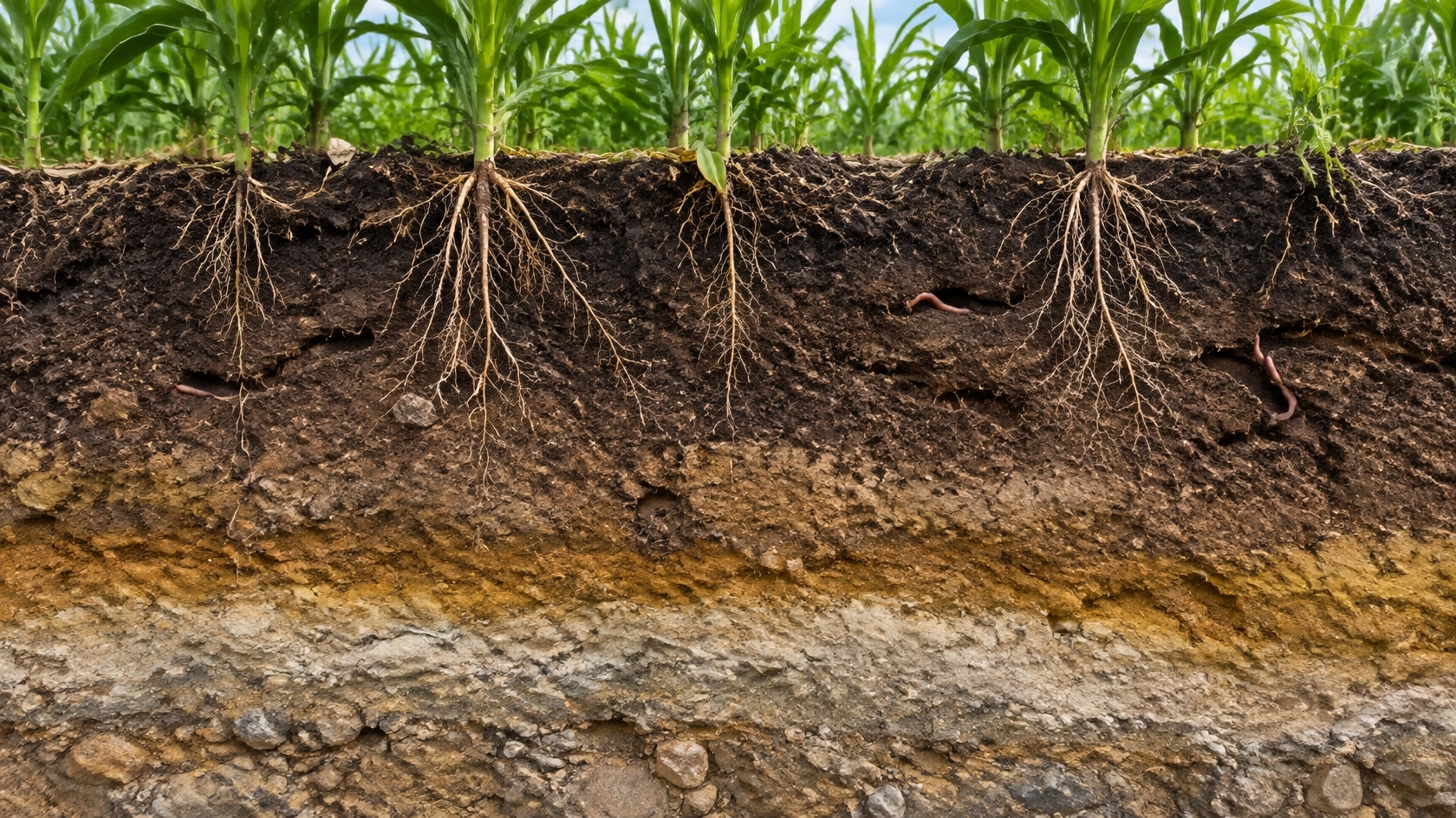
Soil type directly shapes root health and nutrient uptake by controlling how far roots can travel and how much nutrition they can access. The physical resistance of dense soil is one of the most overlooked limits on plant performance, making texture a critical factor in any assessment of growing conditions.
Research shows that soybean root growth decreased by 10% at a soil penetrometer resistance of 0.52 MPa and by 50% at 1.45 MPa, according to PMC/Frontiers in Plant Science. Soil density throttles nutrient access by restricting root volume.
Key ways soil type shapes nutrient uptake include:
- Compaction limits root expansion: Root growth in clay soils ceases at a bulk density of just 1.47 g/cm3, compared to 1.85 g/cm3 for sandy soils, per the USDA-NRCS Bulk Density Guide
- Texture governs nitrogen capture: In sandy loam, more than 90% of applied nitrogen was captured, compared to only 64 to 68% in pure sand soils, according to Nature Scientific Reports
- Organic matter raises water-holding capacity: A 1% increase in soil organic matter raises water-holding capacity by approximately 1.5 to 2.0 mm per cm of soil depth, per Springer Plant and Soil
- Soil health affects yield at scale: Soil health accounts for 12% of yield variation and 22% of nitrogen use efficiency variation in global crop modeling, according to Nature Food
The Soil Food Web: Why Biology Matters as Much as Texture
Texture is only part of the story. The biological community living in soil, including bacteria, fungi and earthworms, drives nutrient cycling and organic matter breakdown. Mycorrhizal fungi extend root reach far beyond what roots can achieve alone.
Healthy microbial populations convert organic inputs into plant-available forms of nitrogen, phosphorus and potassium. Disrupting this web through compaction or overuse of synthetic inputs reduces nutrient efficiency even in otherwise well-textured soil.
Which Soil Type Is Best for Plant Growth
Loam is the scientific and practical consensus choice for most crops and growing systems. Its composition and chemistry create the most favorable conditions across the widest range of plant types.
“High-quality soils produced 10.3% higher mean crop yields and higher yield stability, decreasing variability by 15.6%, compared to lower-quality soils.” – Nature
Loam’s advantages over other soil types include:
- Balanced drainage and retention: The 40/40/20 sand-silt-clay ratio prevents both waterlogging and drought stress
- Optimal pH range: Loam’s natural pH of 6.0 to 7.0 keeps phosphorus, nitrogen and potassium available to roots
- Thermal stability: Loamy soil has the lowest thermal conductivity among tested soil types, supporting stable root-zone temperature, per ResearchGate
- Organic matter support: Loam’s structure supports higher organic matter content, and farms with approximately 3% soil organic matter produce yields about 11% higher than soils with 1.5% SOM, according to the Journal of Soil and Water Conservation
Improving Your Soil: Practical Amendment Strategies for US Growers
More than 70% of farmers in the United States use soil amendments to improve structure and nutrient availability, according to Market.us. The right strategy depends on your starting soil type and production goals.
Testing Soil Before You Amend
Testing before amending prevents waste and over-application. The USDA NRCS recommends testing every 2 to 4 years for most operations, while vegetable gardens benefit from testing every 1 to 2 years, per the USDA NRCS Small Farm Soil Testing Guide. A professional soil test costs approximately $30, a modest investment that prevents costly over-fertilization and guides precise amendment choices.
Building Healthy Soil Over Time
Compost is the most broadly effective amendment across soil types. A global synthesis of 1,657 observations from 204 studies found that compost alone increased yields by 45.1%, while compost combined with NPK increased yields by 62.6%, according to Frontiers in Agronomy.
Regenerative soil management practices have consistently improved soil health indicators on 6 million acres across seven regions of the Southern United States, with average improvements ranging from 11% to 22%, per the Soil Health Institute.
Choosing the Right Growing Media for Container Production
Container production removes soil type from the equation entirely. Professional growers working in greenhouse or nursery settings rely on science-driven growing media rather than native soil.
Sun Gro® Horticulture, North America’s largest producer of horticultural-grade peat and peat-based growing mixes, develops expertly manufactured blends using Canadian sphagnum peat moss, perlite, coir and other ingredients calibrated for specific crop and drainage needs. Choosing the right growing media for containers is as important as soil selection in field production.
Conclusion
Soil types and their impact on plant growth are not abstract concepts. They shape root development, nutrient efficiency and yield outcomes in measurable, documented ways. Growers who understand their soil, whether loam, clay, sand or a mix, are better positioned to make informed decisions about amendments, irrigation and crop selection.
For professional growers and horticulturists working in container production, the right growing media replaces the variability of native soil with consistent, reliable performance. Talk with a Sun Gro Grower Specialist to find the right mix for your crop. Learn more at sungro.com.
Frequently Asked Questions
How much does soil testing cost in the United States?
A professional soil test in the United States costs approximately $30 every three years, or roughly $10 per year. University extension labs and private testing services both offer this at accessible price points.
The agriculture soil sampling and testing market reached US$4.05 billion in 2025 and is projected to reach US$7.8 billion by 2034, reflecting growing grower demand for precision soil data, according to IMARC Group.
How does soil type affect gardening outcomes for US households?
Approximately 55% of US households, around 185.9 million people, participate in gardening, according to the National Gardening Association. Many homeowners plant into native soil without testing first, leading to nutrient imbalances and poor results. Matching plants to soil type, or amending soil before planting, is one of the most practical steps any home gardener can take to improve outcomes.
What pH range supports the best nutrient availability for plants?
Nutrient availability is optimal within a pH range of 6.0 to 7.5 for most macro- and micronutrients, according to UNH Extension. When pH drops below 5.5, microbial activity slows significantly, reducing organic matter breakdown. Chalky soils with pH above 7.5 cause iron and manganese deficiency, while acidic soils below 6.0 limit phosphorus and potassium uptake.
How does loamy soil compare to clay or sandy soil for crop production?
Loamy soil outperforms both clay and sandy soil across most crops. Clay soil’s root-restricting bulk density threshold is reached at just 1.47 g/cm3, while sandy soil’s low nutrient retention means applied fertilizers leach away before roots can use them.
Loam’s balanced texture and stable thermal properties create the most favorable root environment, supporting stronger growth across a wider range of crops and climates.
How can biochar improve degraded or sandy soils?
Biochar application on sandy soils in reclamation studies increased grain yield by 51.6% and soil organic carbon by 74.2%, according to Frontiers in Soil Science. Combining biochar with compost enhanced yields by 155% compared to unamended controls.
Black Bear® Biochar, made from 100% natural renewable forest products, is a sustainable alternative to perlite that promotes aeration and has captured and stored carbon, preventing it from entering the atmosphere.