
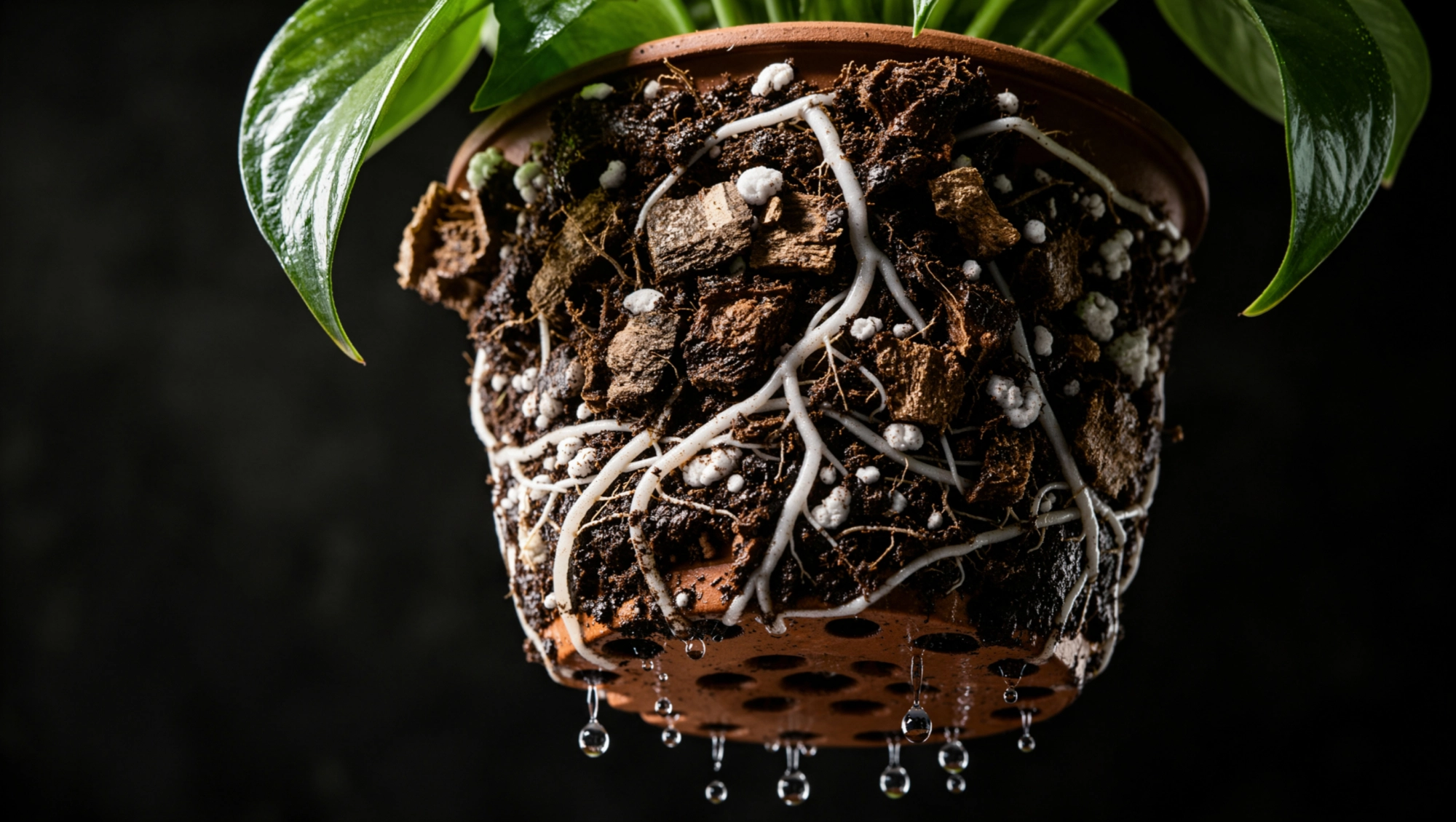
Roots suffocate when growing media can’t drain fast enough. For professional growers and horticulturists, the wrong mix means lost crops, not just slow growth. Understanding what growing mix has high air capacity and fast drainage is the foundation of consistent production.
Introduction
Air-filled porosity (AFP) is the measure that separates productive growing media from problem mixes. It tells you how much pore space holds air after a container fully drains, and that number directly controls whether roots thrive or suffocate.
Most commercial potting mixes are formulated for average conditions. Professional growers need more precision, especially when managing water-sensitive crops or high-frequency irrigation programs.
Getting AFP right protects crops from root rot, reduces input waste and supports consistent performance across production cycles. The ingredients, particle sizes and handling methods all play a role.
What Air Capacity and Drainage Actually Mean in Growing Media
Air-filled porosity (AFP) and drainage describe how much oxygen remains in a growing medium after watering, and that balance directly determines root health. AFP is the threshold between healthy root zones and oxygen-deprived ones. When it falls too low, roots suffocate even in otherwise well-managed crops.
According to UC Agriculture and Natural Resources, healthy container growing requires total porosity of at least 50%, AFP of at least 10% and water-holding capacity of at least 40%. For container nursery production specifically, the desirable AFP range is 20-30%.
Key AFP thresholds every grower should know:
- Root dieback risk: AFP below 15-20% triggers root dieback in most container crops
- Oxygen deprivation: Soil oxygen below 12% inhibits new root initiation
- Container height effect: A 4-inch pot achieves roughly 13% AFP; a 6-inch pot reaches 20% with the same mix
- Drainage layer myth: A 2025 peer-reviewed study in PLOS One found drainage layers almost universally decreased or had zero effect on water retention, never improving it
Ingredients That Boost Air Capacity and Drainage
The ingredients that boost air capacity and drainage work by combining the right particle size, structure, and porosity in a single mix. No single ingredient builds a high-AFP mix on its own. Together, these properties determine whether your growing media performs under pressure in real production conditions.
Perlite: The Top Choice for Air Capacity
Perlite is the most widely used amendment for boosting AFP in professional growing media. Horticultural-grade perlite carries a total pore space of 63%, water-holding capacity of 38% and air-filled pore space of 25% at container capacity, according to University of Arkansas Extension.
Particle size matters significantly. Iowa State University Extension found that switching from fine to coarse perlite at the same ratio in a peat-based mix swings AFP from roughly 21% to 46%, more than doubling aeration without changing the formula percentage.
Which Single Ingredient Drains Fastest?
Parboiled rice hulls (PBH) carry the highest AFP of any common media component, with total pore space of roughly 90% and air-filled pore space of roughly 69%, according to Iowa State University Extension. As perlite costs have risen, rice hulls have become an increasingly practical alternative.
Pumice leads all common materials in air porosity at field saturation at 45%, followed by pine bark at 35%, granite grit at 31% and perlite at 22%, per data from Growers Review. Pumice also holds nutrients through measurable cation exchange capacity, which perlite lacks.
Coir Fiber, Vermiculite, and Peat: Supporting Roles
Coir fiber, vermiculite and peat moss each contribute to mix structure but don’t lead on drainage. Coarse coir fiber above one-quarter inch measures AFP of 0.63 ml/ml, nearly identical to coarse bark. Fine coir drops to just 0.07 ml/ml, confirming that particle size controls performance more than material type.
Vermiculite improves water retention and nutrient holding but reduces AFP when used in large proportions. Canadian sphagnum peat moss provides excellent structure and water holding in balanced mixes, but requires coarse amendments alongside it to maintain adequate air space.
The Best Fast-Draining Growing Mixes for US Growers
The best fast-draining growing mixes for US growers include both manufacturer-formulated options and proven DIY ratios that professional growers have tested across a range of production systems. Several well-tested choices exist for high-AFP production, giving growers flexibility depending on crop type and scale.
Sunshine® Mix #4 from Sun Gro® Horticulture is the only major commercial mix officially rated “High Drainage / Coarse Particle Size / Low Water Retention” and is explicitly recommended by the manufacturer where high air capacity and fast drainage are needed. It suits water-sensitive and salt-sensitive crops and programs requiring frequent leaching. Learn more at sungro.com.
Lab-tested AFP comparisons of commercial US mixes show a wide range of performance, according to The Yield Grid:
- rePotme All-Purpose Orchid Mix: 34% AFP
- Rooted Beginnings Indoor Mix: 22% AFP
- Happy Frog: 16% AFP
- Black Gold Organic: 14% AFP
DIY High-Drainage Mix Ratios
Professional growers building custom mixes use proven starting ratios based on crop type and irrigation frequency.
A 50/50 coco-perlite blend achieves AFP of 25-30% while maintaining 45-50% water-holding capacity, according to research via ResearchGate. Growers running high-frequency automated irrigation often push to a 55/45 coco-perlite ratio for faster dry-back between cycles.
For bark-based mixes, a 1:1:1 ratio of bark, growing mix and pumice or perlite suits tropical aroids well. Succulents and cacti perform best at 75% coarse amendments to 25% standard mix.
Potting Soil Ingredients That Hurt Drainage (And What to Use Instead)
Certain common potting soil ingredients actively hurt drainage by reducing AFP, particularly as they break down over time and compact around roots. Identifying these materials early lets growers swap them for alternatives that maintain structure and oxygen availability throughout the full production cycle.
Ingredients to Limit in High-AFP Mixes
Peat moss becomes hydrophobic when it dries completely. The organic fibers shrink and lock together, forming a water-repellent mass that pulls away from pot walls. Without coarse amendments, a peat-led mix will compact and lose structural integrity within the first year, according to PlantsMag.
Research from Texas A&M AgriLife Extension found that compacting a container mix from light to heavy loading drops AFP from 19% down to 8%, crossing below the critical suffocation threshold. Garden soil used in containers compacts immediately and prevents drainage.
Ingredients to limit or avoid in high-AFP mixes:
- Fine coir: AFP drops to just 7% in fine-particle form; use coarse coir fiber instead
- Unamended peat: Breaks down into finer particles over 12-18 months, reducing AFP until the mix behaves like field soil
- Garden soil: Too dense for containers; compacts on first watering
- Excessive vermiculite: Improves moisture retention but reduces air space when overused
How to Test and Improve Drainage in Your Current Growing Mix
You can test and improve drainage in your current growing mix using basic equipment, without sending samples to a lab. Growers can run reliable field checks that reveal AFP problems early. Catching low drainage before it affects roots gives you time to amend or replace the mix before crop losses occur.
Signs Your Growing Mix Lacks Air Capacity
Root disease is the clearest signal. In a study on Phytophthora cinnamomi root rot in rhododendrons, plants grown in media with less than 10% AFP developed severe root rot, while those in media with 10-20% AFP appeared relatively healthy, according to ResearchGate. Oregon State Extension reports that when AFP stays above 30%, Phytophthora root rot drops dramatically.
A quick field test: pour one quart of water into a loosely filled pot. If it drains completely in about one minute, drainage is adequate. If water pools on the surface for more than two to three minutes, AFP is insufficient, per Dave’s Garden.
For a scientific AFP measurement, submerge a filled container in water for 24 hours, block drain holes, lift out and let drain for 30 minutes, then collect the drained water. Calculate: Air Space (%) = Drained Water Volume divided by Container Volume multiplied by 100, per the Landscape Ontario Factsheet.
Practical improvement ratios by plant type, from Healthy Houseplants:
- General houseplants: Add 20-30% coarse perlite to any commercial mix
- Tropical aroids: 1 part bark + 1 part mix + 1 part pumice or perlite
- Succulents and cacti: 75% amendments (pumice plus bark) to 25% standard mix
- Orchids and epiphytes: 60% amendments to 40% potting mix
Iowa State University Extension also confirms that packing method alone can drop AFP from 15% to just 4% in the same container with the same mix. Never stack filled containers on top of each other, and never press media down by hand at potting time.
Conclusion
Choosing growing media with high air capacity and fast drainage comes down to three decisions: ingredient selection, particle size and handling at potting time. Each variable shapes AFP independently, and all three must align for consistent crop performance.
Professional growers who understand AFP thresholds, test their media regularly and match mix formulations to crop requirements gain a measurable advantage in root health and production consistency. Sun Gro® Horticulture supports that process with science-driven growing media developed by professional horticulturists. Talk with a Sun Gro Grower Specialist or learn more at sungro.com.
Frequently Asked Questions
What growing mix has high air capacity and fast drainage for US growers?
Sunshine® Mix #4 from Sun Gro® Horticulture is the only major commercial mix officially rated for high air capacity and fast drainage in the United States. It’s classified as High Drainage / Coarse Particle Size / Low Water Retention and is recommended for water-sensitive and salt-sensitive crops. For growers building custom mixes, coarse perlite or pumice at 30% or more of total volume reliably achieves the 20%+ AFP that most crops require.
How does container size affect AFP in the United States?
Container height significantly changes AFP even when using the same growing mix. In the United States, growers using shallow propagation trays may see AFP as low as 0.5-2.8%, while a standard 6-inch pot with the same media reaches 20% AFP. Taller containers drain better because gravity pulls water further from the root zone. Growers switching from shallow trays to deeper containers often see immediate improvements in root development without changing their mix formula.
What AFP percentage do different crops actually need?
AFP requirements vary widely by crop. Azaleas and orchids require more than 20% AFP; snapdragons and begonias perform well at 10-20%; poinsettias and chrysanthemums need 5-10%; carnations and geraniums can tolerate as little as 2-5%. Most tropical aroids thrive at 15-25% AFP. Matching your mix’s measured AFP to your specific crop’s threshold, rather than using a general-purpose mix, is one of the most direct ways to reduce root disease pressure.
Is perlite or pumice better for drainage in a growing mix?
Pumice leads all common media materials in air porosity at field saturation at 45%, compared to perlite at 22% in the same comparison. Pumice also holds nutrients through cation exchange capacity, which perlite lacks entirely. However, perlite is more widely available across the United States and costs less per unit volume. For most professional growers, coarse perlite is the practical starting point, with pumice reserved for specialty crops like orchids, succulents and high-value container production.
How long does a high-AFP growing mix stay aerated?
Most peat-based mixes begin losing air space within 12-18 months as organic matter breaks down into finer particles, reducing pore size and drainage capacity. Inorganic amendments like pumice and biochar maintain their physical structure far longer because they don’t decompose. Growers running multi-season crops should test AFP at potting time and again mid-season. Aeration porosity can shift significantly over a single production cycle, especially in warm, humid conditions that accelerate organic breakdown.