

Customers have inquired about using mycorrhizae in Sun Gro mixes. Many are not familiar with mycorrhizae, and the confusing, misleading information in the industry about these beneficial organisms does not help with awareness. This article is intended to answer questions and provide a factual explanation of mycorrhizae―what these organisms are and how they benefit plants and production.
–Michelle Miller, Rick Vetanovetz
Read More in The Sun Gro’er Issue 5/2 (2010)
Leer más en The Sun Gro’er Issue 5/2 (2010) Spanish/Español
Author: Jan Perez
A Perlite Primer – The Big White Stuff
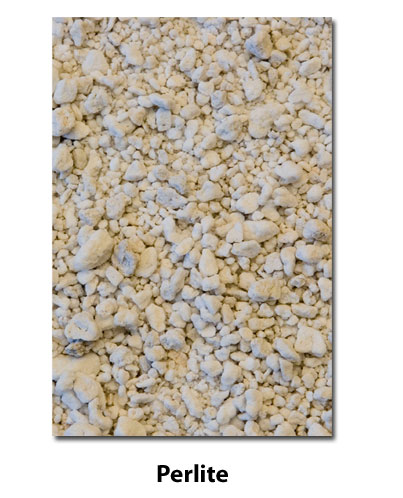 Large, coarse perlite alone may not be the best aggregate for a peat-based growing medium. In general, a mix of different sizes is desirable to provide uniformly distributed air spaces and to avoid the negative aspects of the ‘sand & rocks effect’ or in this case the ‘peat and rocks effect.’ How do sand and rocks relate to a growing medium? You’ve probably seen the demonstration (often used in time management presentations). –Kathryn Louis
Read More in The Sun Gro’er Issue 5/1 (2010)
Leer más en The Sun Gro’er Issue 5/1 (2010) Spanish/Español
The Truth About Soluble Salts
On a greenhouse visit some time ago, I asked a new grower, “What fertilizer rate are you using?” To my surprise he replied, “I don‘t know.” I left the greenhouse fairly concerned, but after some contemplation decided that perhaps I shouldn’t be. Why? Because the fertilizer rate a grower provides to a crop is only one component affecting the crop‘s nutritional status. Factors such as fertilizer source, leaching fraction, irrigation method and plant development stage can dramatically affect the fertilizer rate that is necessary.
–Kathryn Louis
Read More in The Sun Gro’er Issue 5/1 (2010)
Leer más en The Sun Gro’er Issue 5/1 (2010) Spanish/Español
Realigning Our Professional Brands
Sun Gro has added many professional products over the years, and it‘s time to simplify. We set out to use our brands to organize our professional products in a manner to simplify what we have and by virtue help others understand the products Sun Gro offers. So we came up with a way to use our two common brands to organize our professional products in a way that our customers can understand.
Read More in The Sun Gro’er Issue 5/1 (2010)
Leer más en The Sun Gro’er Issue 5/1 (2010) Spanish/Español
Why Sun Gro Belongs to Trade Organizations
Providing high-quality growing media and fertilizers is no longer the simple business of years past, where we simply produced and shipped products for you to grow flowers and trees. The horticulture industry, like most others, has become a highly regulated business. We now need to fill out mountains of paperwork and often need to respond to new unknown “regulations.” A tool that we have found useful to help us keep up with current regulations is participation in trade organizations.
Read More in The Sun Gro’er Issue 4/1 (2009)
Bedding Plant Production Tips
Bedding plants are the “main event” during the spring season. You might be thinking: “bedding plants…like spring crops?” Well, yeah. And planting time will come around before you know it. So, start thinking about how your going to make this year’s crop the best ever. Here are a few things to remember to do when producing your bedding beauties…
Read More in The Sun Gro’er Issue 4/1 (2009)
Harmonizing Peat and Lime
Read More in The Sun Gro’er Issue 3/3 (2005)
Growing media pH is a perennial subject of interest in our industry. One reason is that unlike mineral soils where plants grow naturally, peat mixes are not well buffered against pH changes. Another reason is that, again, unlike natural conditions where plants can grow more roots in favorable pH zones, the limited volume of mix in containers exacerbates pH effects. Drastic pH changes upset plant quality (figure 1).
Continue reading “Harmonizing Peat and Lime”
How Using the Correct Soilless Media Will Help Your Success with Tissue Culture Propagation
Tissue culture (also called “in vitro culture” or “micro-propagation”) is one method of cloning plants that is becoming more and more common. In many ways, it is similar to clonal propagation by cuttings; in each method, part of the plant is removed from a stock plant and after a multiplication stage (in an enclosed, sterile environment in the case of tissue culture) is placed in a rooting environment and then acclimated to the real world. Choosing the correct soilless medium for the rooting and acclimation process, ex vitro, can help reduce losses with tissue culture propagated plants.
Read More in The Sun Gro’er Issue 3/2 (2005)
Using Multicote® to Supplement a Standard Fertilizer Program
Most greenhouse crops can effectively be grown with either a water soluble fertilizer regimen or through the use of controlled release fertilizers. In general, growers tend to use a water soluble program because they feel they have better control over fertilizer needs of the crop. (They can easily reduce or increase fertilizer as needed.) For many crops, such as bedding plants in standard flats, the water soluble regimen is the better way to go because small cells do not readily lend themselves to even distribution of a controlled release fertilizer. However, with the advent of the larger cell packs, such as Jumbo Packs and the 2¼ “ liners, controlled release fertilizers can be successfully used for general bedding plant production. –Daniel Jacques
Read More in The Sun Gro’er Issue 3/2 (2005)
The Storage and Handling of Sun Gro Products
It has always been Sun Gro’s policy, as the makers of Fafard, Sunshine Mixes, Metro Mixes, Peat Moss and Technigro, to produce and ship these products in an environment that is free of toxic contaminants. To that end, we do not keep herbicides or other harmful chemicals in or near our manufacturing facilities and make every effort to select trucks that have not carried any potential toxins, requiring them to be cleaned prior to loading. The same safety measures are also practiced at our distributor and customer facilities. To that end, we offer these storage and handling guidelines and ask for your cooperation to maintain the quality of the Sun Gro products you receive.
Read More in The Sun Gro’er Issue 3/1 (2005)