
The professional growing industry shapes how food, flowers and ornamental plants reach consumers across the United States. With thousands of organizations, agencies and associations influencing everything from research funding to regulatory standards, knowing who holds influence matters. The top organizations influencing the professional growing industry determine which innovations reach growers first.
Introduction
The U.S. horticulture sector is larger and more interconnected than many people realize. Trade associations, federal agencies, research institutions and industry events all play distinct roles in shaping how professional growers operate, compete and grow.
Understanding these organizations helps growers make smarter decisions about membership, advocacy and professional development. The right connections can open doors to funding, research insights and policy influence that directly affect day-to-day operations.
For professional growers, horticulturists and garden retailers, staying informed about who shapes the industry is not optional. It is a competitive advantage that separates well-positioned operations from those reacting to change rather than anticipating it.
Why the Growing Industry Is Expanding in the US
Consumer demand, new growing technologies and a growing base of commercial operations are driving expansion across every major segment of the U.S. professional growing sector. The United States operates over 3,500 commercial greenhouses and holds approximately 87.5% of the total North American greenhouse horticulture market as of 2025.
Key growth indicators include:
- Total sales volume: U.S. horticulture operations sold $18.3 billion in floriculture, nursery and specialty crops in 2024, according to USDA NASS
- Market size: The U.S. gardening market reached $24.98 billion in 2026 and is projected to hit $30.29 billion by 2032, per MarkNtel Advisors
- Economic impact: The broader horticulture industry supports 2.95 million jobs and contributes $520 billion annually to the U.S. economy
- Business growth: There are 45,999 businesses in the U.S. plant and flower growing industry, per IBISWorld
- Cut flower surge: The number of firms reporting cut flower sales jumped 64.5% between 2019 and 2024, the largest percentage gain of any horticulture segment
Leading Trade Associations Every Grower Should Know
AmericanHort and the Society of American Florists are the two trade associations with the greatest reach and influence for professional growers in the United States. They serve as the primary voice of the industry in policy, research and education, collectively representing thousands of companies and associates nationwide.
AmericanHort: The Industry’s Largest Advocate
AmericanHort is the primary national trade association for the green industry, formed in 2014 through the merger of ANLA and OFA. It serves more than 1,800 company members and 20,000 associates across the United States.
AmericanHort hosts Cultivate’26 (July 11-14, Columbus, OH), North America’s premier horticulture trade event, drawing 10,000 attendees and 650 exhibitors from all 50 states and 40 countries. Its foundation, the Horticultural Research Institute, is the primary private funder of green-industry research in the country.
Society of American Florists and Specialty Growers
The Society of American Florists (SAF), chartered by Congress in 1884, is the only national trade association representing all segments of the U.S. floral industry. With 2,500 members, SAF has secured $6.4 million in annual federal funding through the Floriculture and Nursery Research Initiative, according to Sun Gro Horticulture.
The American Society for Horticultural Science (ASHS), established in 1903, rounds out the landscape with 2,400 members from more than 60 countries and three peer-reviewed journals including HortScience, which carries an H-Index of 112.
Research Institutions Advancing Growing Science
The USDA Agricultural Research Service, university programs and private funders such as the Horticultural Research Institute are the institutions most directly advancing growing science in the United States. Their work produces better growing media, more efficient substrates and higher-performing crops that commercial growers rely on every season.
USDA Agricultural Research Service
The USDA Agricultural Research Service (ARS) ranks among the top institutions globally by publication count in horticulture research. The broader USDA Specialty Crop Research Initiative (SCRI) provides up to $175 million per year for integrated research and extension projects, per USDA NIFA.
Current SCRI emphasis includes automation, AI, mechanization and sensors to reduce labor in specialty crop production. These programs directly fund advances in growing media science, pest management and crop production systems used by commercial growers.
University Extension Programs and CEA Research
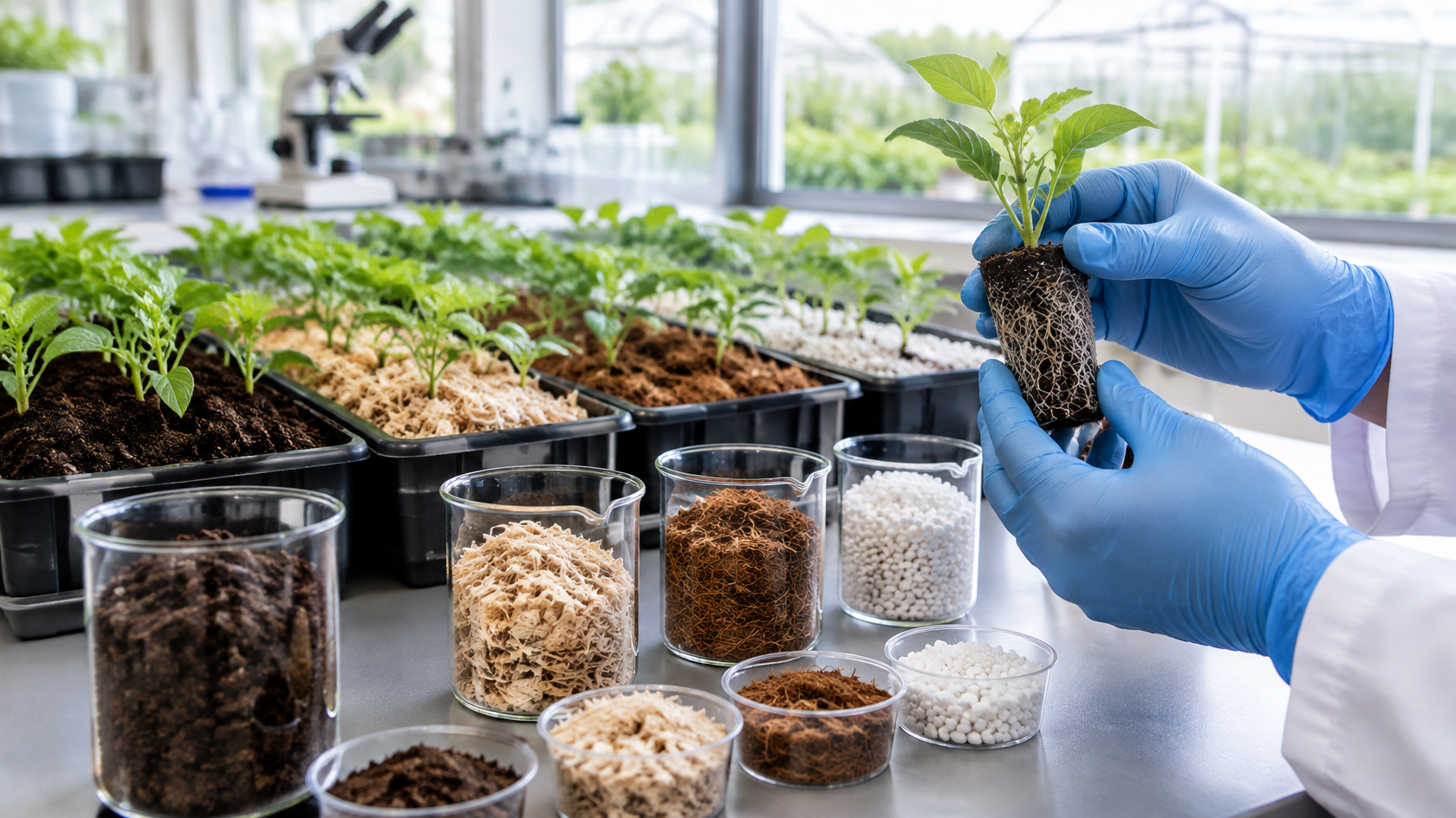
University programs are accelerating innovation in controlled environment agriculture and soilless substrate science. Dr. Jeb Fields at UF/IFAS leads the Beyond Peat project and the national S3 (Soilless Substrate Science) team, developing peat alternatives for commercial growing. Brian E. Jackson at NC State University directs the Horticultural Substrates Laboratory, focusing on engineered wood fiber and soilless growing media innovation.
The ASHS 2025 Annual Conference in New Orleans highlighted advances in plant breeding, sustainable floriculture and controlled environment agriculture, reflecting how university research is shaping the next generation of professional growing practices.
Organizations Driving Sustainability and Innovation in Horticulture
Several organizations now set the measurable operational benchmarks that define sustainability standards for professional growers. Sustainability has moved from a marketing message to a compliance expectation, and these organizations determine the criteria growers are expected to meet across production, inputs and environmental impact.
Horticultural Research Institute Grant Programs
The Horticultural Research Institute (HRI) has invested more than $11 million in research funding to date, with over $20 million committed to its endowment. In 2026, HRI announced $564,521 in funding for 18 projects, per HRI. These grants cover soils and substrates, pest management and plant nutrition, directly supporting the science behind professional growing media development.
Beyond HRI, several organizations are setting global sustainability standards:
- MPS: Operating in 52 countries for 30 years, MPS-ABC certification tracks crop protection agents, fertilizers, energy, water and waste across certified operations
- GLOBALG.A.P.: Certifies over 200,000 producers in 134 countries, covering more than 4.5 million hectares of certified plant production annually
- CEA Alliance: Brought 25 members to Washington, D.C. in April 2025 to advocate for the bipartisan Supporting Innovation in Agriculture Act
Government Agencies That Shape Growing Regulations
Federal agencies set the regulatory environment that every professional grower must navigate, and their decisions directly affect operational costs and market access. Their funding priorities and compliance requirements shape which practices, inputs and technologies are available to commercial growers across the United States.
Key agencies and programs include:
- USDA FSA (MASC Program): The Marketing Assistance for Specialty Crops program authorized $2.65 billion in payments, with $900 million delivered in the first round and $1.3 billion approved in a second round in April 2025, per USDA FSA
- USDA NIFA (SCRI): Specialty Crop Block Grants reached $100 million in FY2026, supporting state-level growing programs
- USDA APHIS PPQ: Maintained compliance agreements with 555 businesses in FY2025 that moved regulated host plant materials, protecting nursery stock from invasive pests
- EPA (Worker Protection Standard): Requires pesticide safety training and exposure mitigation across nurseries and greenhouses, with new chemistry approvals now averaging up to 12 years
Industry Events and Publications That Set the Agenda
The top organizations influencing the professional growing industry make their presence felt most visibly through events and publications that set research priorities and commercial trends.
Leading events and media include:
- Cultivate’26: 160 educational sessions, 350,000 square feet of exhibit space and over 93% of attendees recommending the event to peers, per AmericanHort
- GreenTech Amsterdam 2025: Drew 11,800 visitors from 120 countries with 80 sessions across themed theaters covering AI, robotics and crop intelligence
- GrowerTalks Magazine: Founded in 1937, it remains the leading trade publication for flower and plant production professionals
- Greenhouse Grower: Serves the controlled-environment production market with technical content for commercial operations
- AIPH International Statistics Yearbook: Volume 73 published in 2025, covering ornamentals production and trade data across 40 countries
How Professional Growers Can Engage With These Organizations
Knowing which organizations matter is only the first step. Active engagement through membership, credentialing and events is where growers gain real competitive advantage.
Practical engagement options include:
- AmericanHort membership: Starts at $295 per year, with higher tiers offering exhibit discounts at Cultivate, benchmarking data access and multilingual training resources in English and Spanish, per AmericanHort
- ASHS Professional Membership: $135 per year, including access to three peer-reviewed open-access journals, continuing-education webinars and discounted job postings through the ASHS Career Center
- HortCred micro-credentials: AmericanHort’s 2025 program offers CORE, PRO and LEAD digital badges across six topic areas including Soils and Substrates, Irrigation and Plant Nutrition
- HRI Scholarship Program: Awarded $62,000 in support to 18 students in the 2025-2026 academic year, with the HRI Leadership Academy Class of 2026 announced in July 2025
- HortScholar program: Provides scholarship recipients with a full pass to Cultivate, hotel, meals, mentorships and career development sessions, per AmericanHort
Conclusion
The professional growing industry in the United States is shaped by a dense network of trade associations, research institutions, government agencies and industry events. Each plays a distinct role in setting standards, funding innovation and connecting growers to the resources they need to compete.
Professional growers who actively engage with these organizations gain access to research, policy influence and peer networks that strengthen their operations. For companies like Sun Gro® Horticulture, which works alongside professional growers across North America, understanding this landscape is part of delivering the science-driven growing media solutions that today’s horticulture demands.
Frequently Asked Questions
What does AmericanHort membership cost in the United States?
AmericanHort membership in the United States starts at $295 per year for the Basic tier. Higher tiers unlock additional benefits including exhibit space discounts at Cultivate, priority hotel access and up to 75% off office supplies through ODP Business Solutions. All membership tiers include access to industry benchmarking data, peer networking through Community Connectors groups and multilingual training resources.
How does the United States rank in the global horticulture market?
The United States accounted for approximately 87.5% of the total North American greenhouse horticulture market in 2025 and operates over 3,500 commercial greenhouses, per Market Data Forecast. North America holds a 32.4% share of the global greenhouse horticulture market.
The global horticulture market is projected to grow from $80.78 billion in 2025 to $142.38 billion by 2034 at a 6.50% CAGR.
What certifications are available to professional horticulturists?
ASHS offers three national credentials: the Certified Professional Horticulturist (CPH) requiring five years of experience with a bachelor’s degree, the Practicing Professional Horticulturist (PPH) requiring five or more years of full-time experience without a horticulture degree, and the Associate Professional Horticulturist (APH) for early-career professionals.
AmericanHort’s HortCred program adds micro-credential badges at CORE, PRO and LEAD levels across six topic areas, per ASHS.
How do growers compare financially to prior years?
In 2025, 78% of growers reported higher year-to-date sales and 74% said profits were up year-over-year, according to AmericanHort Chief Economist Dr. Charlie Hall, per Sun Gro Horticulture. These figures reflect strong consumer demand for plants, flowers and food crops grown in controlled environments, reinforcing the value of staying connected to organizations that track and report industry performance data.
How can a grower get started with HRI research funding?
HRI accepts grant applications from researchers at accredited institutions, with 16 projects receiving $531,900 in 2025 and 18 projects receiving $564,521 in 2026. Growers can support HRI through AmericanHort membership or direct endowment contributions.
The HRI Leadership Academy and Scholarship Program offer additional pathways for professionals and students to connect with the green industry’s primary private research funding network, per HRI.