
American farms are under more pressure than ever. Labor shortages, climate volatility and rising input costs are forcing growers to rethink how they operate. Innovative technologies transforming agriculture today offer a path forward, and the data shows adoption is accelerating fast.
Introduction
Agriculture is changing faster than at any point in recent memory. Digital tools, biological innovations and autonomous machinery are reshaping how food is grown, managed and delivered across the United States and beyond.
The global AgTech industry is projected to grow from $26.47 billion in 2025 to $82.22 billion by 2035, according to Market Research Future. That growth reflects real demand from professional growers who need better answers to real problems.
Understanding these trends helps growers, horticulturists and agricultural businesses make smarter decisions about where to invest and how to stay competitive. The stakes are high, and the window for early adoption is open right now.
What ‘Innovative Agtech’ Actually Means Today
Innovative agtech today is a broad category spanning digital tools, mechanical systems, biological innovations and data-driven platforms applied across farming’s 4.8 billion hectares of agricultural land. It is not a single product or platform, but rather a convergence of technologies reshaping how food is grown, managed and delivered at commercial scale.
Key segments shaping the industry today include:
- Precision agriculture: The largest AgTech segment, valued at $15.1 billion in 2025 and growing at a 12.7% CAGR, according to Grand View Research
- AI-driven platforms: Commanding over $2 billion in investment in 2025, per AgFunder
- Biological innovations: Attracting over $2.5 billion in funding alongside gene editing
- Autonomous machinery: Delivering measurable field results at commercial scale
- Controlled environment agriculture: Expanding rapidly, with North America holding 41.4% of the global vertical farming market
Why US Farmers Are Adopting New Technology Now
American growers are adopting new technology now primarily because labor shortages and rising costs leave them few alternatives. The pressure is real and growing, pushing farms of all sizes to evaluate tools that reduce dependence on manual labor and improve the efficiency of every input dollar spent.
Adoption is accelerating for several interconnected reasons:
- Labor scarcity: 56% of U.S. farms have begun using some form of new ag tech, with more than half citing labor shortage as the primary driver, per FTI Consulting
- Workforce dependency: 73% of U.S. farms depend on immigrant workers, according to USDA via AEI, making immigration policy a direct accelerant for technology adoption
- Cost pressure: 80% of farmers who adopted a labor-saving technology did so because of rising labor costs, per Wiley/AEPP
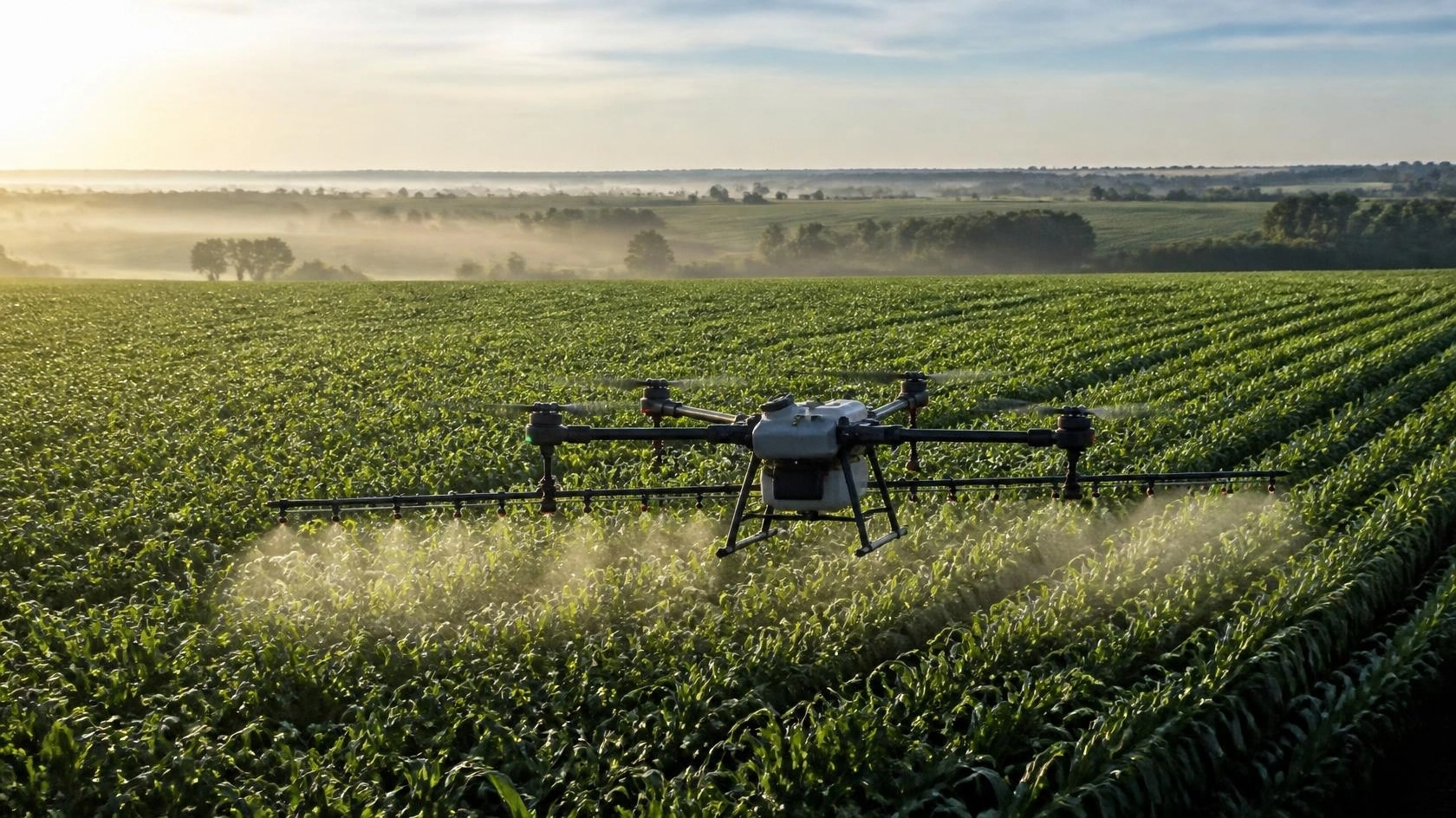
- Drone surge: FAA-approved drone operators treated 16.3 million U.S. acres in 2025, up 57% year-over-year, per USDA data
- Generative AI use: 17% of farmers globally now use generative AI for farm-related work, according to McKinsey
7 Agricultural Technologies Reshaping Farms Right Now
Seven technologies are reshaping farms right now through measurable impact on productivity, input efficiency and farm profitability. Three of these deserve particular attention for their rapid commercial adoption, as growers across the United States and other major markets move from pilot programs to full-scale deployment.
AI Robotics and Automation
Robotics and automation are solving the labor gap directly. John Deere’s second-generation autonomy kit operates at 12 mph, a 40% increase over its predecessor. During testing, one farmer shortened post-harvest tillage by two full weeks, according to Design News.
John Deere’s ExactShot fertilizer system cut fertilizer use by 60%, saving an estimated $650 million annually across U.S. operations. These are not prototype results. They are commercial outcomes from equipment already in the field.
AI-Powered Precision Agriculture
Artificial intelligence is the engine behind modern precision agriculture. The AI-in-agriculture market reached $2.71 billion in 2025 at a 21.6% CAGR, with precision farming holding the largest application share at 43.29%, per Mordor Intelligence.
Variable Rate Technology (VRT), one of the most widely deployed AI applications, has delivered yield increases of up to 62% alongside fertilizer reductions of 60% and pesticide reductions of 80% in documented field applications, according to market.us.
Controlled Environment Agriculture
Controlled Environment Agriculture (CEA) removes weather and geography from the yield equation. The global vertical farming market is valued at $8.52 billion in 2025, with hydroponics leading at 56.7% of market share, per Fortune Business Insights.
Vertical farms can produce 30 times more lettuce per square meter than traditional farms and enable up to 15 harvests per year. Aquaponics is also gaining ground as growers combine fish production with plant cultivation in closed-loop systems.
AeroFarms, operating in Danville, Virginia, achieved three consecutive quarters of profitability and commands over 70% U.S. retail market share for microgreens, per BusinessWire.
Biotechnological Advancements Changing What Crops Can Do
Biotechnology is rewriting what crops are capable of, expanding tolerance to drought, disease and pests while improving nutritional profiles. The global agricultural biotechnology market was valued at $151.23 billion in 2024 and is projected to reach $212.57 billion by 2030 at a 7.1% CAGR, according to Grand View Research.
CRISPR and Next-Generation Breeding
CRISPR gene editing is moving from laboratory to commercial field faster than most expected. The CRISPR-in-agriculture market was valued at $0.98 billion in 2025 and is projected to reach $4.14 billion by 2034 at a 17.5% CAGR, per Dataintelo.
USDA and FDA have cut gene-edited crop approval timelines from 8-10 years to 3-4 years, according to Cell Trends in Plant Science00363-2). India’s ICAR released two gene-edited drought-tolerant rice varieties in 2025 showing a 10-30% yield advantage under stress conditions. CRISPR-edited products including GABA tomatoes, soybeans and white button mushrooms are already on market in the United States.
From Lab to Field: Innovative Agricultural Products in Use Today
Innovative agricultural products are moving from lab to field faster than at any previous point in the industry’s history. Global agrifoodtech funding reached $16.2 billion in 2025, with upstream farm-facing startups attracting $9 billion, up 7% year-over-year, per AgFunder, narrowing the gap between research and commercial deployment.
Renewable Energy as a Farm Input
Renewable energy is becoming a core farm input, not just an environmental gesture. The agricultural biologicals market is valued at $18.44 billion in 2025, growing to $34.99 billion by 2030 at a 13.7% CAGR, per MarketsandMarkets.
Microbial products capture approximately 60% of the biologicals market due to proven efficacy at commercial scale. Precision fermentation is also scaling rapidly, with the global market valued at $7.4 billion in 2025 and more than 163 specialized companies developing fermentation-enabled proteins, per Research and Markets.
The vertical farming sector is maturing through consolidation, with survivors like AeroFarms demonstrating that profitability is achievable when operations are tightly managed.
Climate-Smart Agriculture: Technology Meets Sustainability
Climate pressure is making technology adoption a strategic necessity. Food systems account for approximately 30% of total global greenhouse gas emissions, per the Lancet Commission, and agriculture will need to increase output 60-70% by 2050 to feed a global population approaching 10 billion.
Climate-smart agriculture solutions are scaling to meet that challenge:
- Market size: The Climate-Smart Agriculture Solutions Market was valued at $36.60 billion in 2025, projected to reach $93.90 billion by 2033, with North America holding 39.8% of global revenue share, per Data Bridge Market Research
- USDA investment: $3.1 billion across 141 projects connecting 14,000+ farms and 3.2 million acres to climate-smart practices, sequestering 400,000 metric tons of carbon so far, per USDA
- Water efficiency: AI-driven irrigation systems achieve 30-50% water savings and 20-30% increases in crop productivity over traditional methods, per ScienceDirect
- Global investment: AIM for Climate partners have mobilized $29.2 billion in increased investment in climate-smart agriculture above a 2020 baseline, per USDA
- Platform convergence: Regenerative agriculture platforms like Indigo Ag and Regrow are enabling farmers to track soil health, carbon sequestration and water use through AI-driven data systems
Conclusion
The technologies reshaping agriculture today are not experimental. They are delivering measurable results on working farms across the United States, from autonomous machinery cutting tillage time to gene-edited crops tolerating drought without sacrificing yield.
For professional growers and horticulturists, the question is no longer whether to adopt new tools but which ones fit their operation and timeline. The growers who engage with these innovations now, whether through precision agriculture, controlled environment systems or biological inputs, are building a foundation for long-term resilience and productivity.
Frequently Asked Questions
What does precision agriculture cost for U.S. farms?
Precision agriculture costs vary widely depending on technology type and farm scale. USDA’s Environmental Quality Incentives Program reimburses farms up to 75% of smart irrigation controller costs, cutting payback periods from five years to under two years.
For a 1,000-acre row-crop operation in the United States, a 2025 AEM study found that precision ag adoption translates to roughly $66,000 in additional annual revenue through yield gains and input savings.
How widely is AgTech adopted across the United States?
In 2025, 22% of all U.S. farms used precision agriculture practices overall, per USDA NASS. Adoption jumps to 68% among large-scale crop farms with gross income above $350,000.
Internet access now reaches 85% of U.S. farms, and 50% used the internet to purchase agricultural inputs in 2025, up 18% from 2023. The United States remains one of the most active AgTech adoption markets globally.
How much water can smart irrigation technology actually save?
Smart irrigation systems deliver significant water savings at commercial scale. Drip irrigation cuts water use by up to 60% compared to flood irrigation, and IoT sensor systems have been documented reducing water use by 28.8% while cutting pumping hours by 16.5% in peer-reviewed tests, per Springer.
Agriculture currently accounts for 70% of global freshwater consumption, making these efficiency gains critical for long-term farm viability.
How do agricultural drones compare to traditional crop treatment methods?
Agricultural drones deliver an ROI of $2-$12 per acre and could save corn, soybean and wheat farmers $1.3 billion annually, per Jouav. Iowa State University field studies showed herbicide reductions averaging 76% across 415 acres, with direct chemical cost savings of $15.70 per acre.
Payback periods typically run one to two years, making drones one of the fastest-returning technology investments available to commercial growers today.
How quickly can a farm implement CRISPR-based crop varieties?
Regulatory timelines for gene-edited crops have shortened considerably. USDA and FDA now process approvals in 3-4 years, down from the previous 8-10 year timeline. Several CRISPR-edited products are already commercially available, including GABA tomatoes and gene-edited soybeans.
For growers interested in stress-tolerant varieties, field trials for high-yielding drought-resistant rice are underway in the United States, India and other markets, with commercial availability expected within the current decade.