
Origins of wood substrate and where it is going
BY BRANDON YEP
If you’ve attended any of the industry or scientific events in the past couple of years, it’s nearly impossible not to hear about wood fiber as a growing media component. With good reason, too—low cost, increase in availability and proven commercial success. Globally, the demand for growing media (e.g., peat, bark, coir, stone wool, etc.) is expected to rise dramatically in the coming years. Of all the different growing media components, wood fiber is estimated to have one of the largest increases: 1000% by 2050 from 2017 levels.
Industry Challenges Driving Wood Fiber Interest
You may ask: “why all the interest in wood fiber now? My peat-lite mix has never failed me.” The wood fiber trend began in Europe. Starting back in 2011, environmental groups in the United Kingdom brought up concerns on peat consumption due to the non-sustainable harvesting occurring in the region. This eventually led to many European countries placing regulations in 2024 to phase out the amount of peat that could be used in growing media. This was driven by non-sustainable peat harvesting done for non-horticultural purposes, such as fuel and urbanization. Thus, in Europe, there was a need for a peat alternative.
The situation was different in North America. At Sun Gro, along with the vast majority of Canadian peat companies, peat harvesting is done sustainably, with bogs being restored to their natural order after harvesting. There is no shortage of peat in Canada, but there can be a shortage of suitable harvest days.
Peat shortages were caused by weather and demand. Right after the initial COVID-19 pandemic (2020–2023), the greenhouse industry boomed in North America and poor weather conditions limited the amount of peat that could be harvested, causing a weather-induced peat shortage. Pair that with the new unhindered supply of commercial wood fiber, and many growers began to make the switch to wood fiber mixes.
In addition to supply constraints, there has been increased pressure to reduce input costs. Reducing input costs has always been an ongoing goal for growers and businesses, but in recent years, it seems that growers’ margins are being squeezed more than ever.
Retailers are not necessarily paying more for plants, while other inputs—like fertilizer and labor—have steadily climbed. Growing media manufacturers are acutely aware of this and have been trying to find ways to reduce costs for their customers. Wood fiber offers a low-cost alternative compared to perlite and peat in some locations, as it is a byproduct from the lumber industry and can be sourced more locally to mix plants in the US.
Finally, the availability of commercial wood fiber options that have been proven scientifically or in commercial trials has exploded in recent years. Indeed, a recent article reported 63 wood fibers for growing media being sold commercially globally (mainly in Europe), spanning 25 countries with various production methods. There were challenges with using wood byproducts to grow plants many years ago; however, the innovation in processing wood byproducts in recent years has dramatically improved the quality of the material and has been showcased as a viable growing medium across numerous scientific articles.
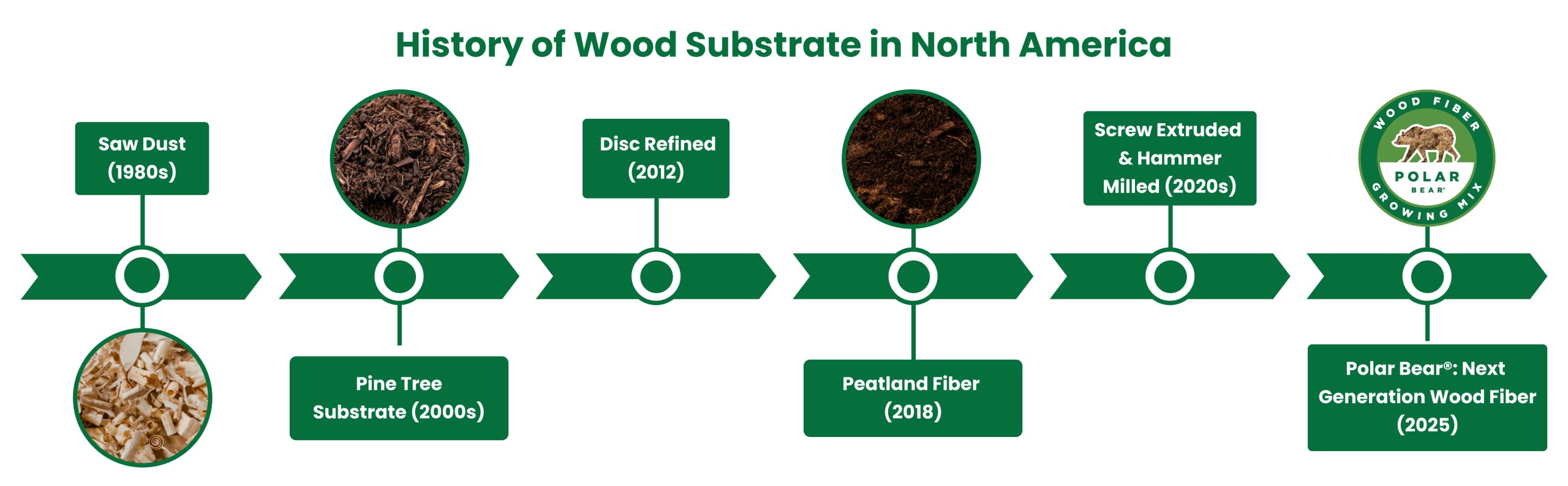
You may be surprised to hear that although wood fiber is just taking off commercially now, it has been in development since the 1970s! See below to learn how wood fiber has grown from a niche, more risky media component to a dependable growing media component.
European Origins (1970s)
Like many innovations and trends, the Europeans were ahead of the curve. The concept of using waste lumber or wood material for growing media first originated in Europe in the late 1970s as scientists and growers explored whether the wasted wood material from local lumber mills could be used to grow plants.
This was first reported in 1984, when a French manufacturing company—ELF—developed a method to produce a “lignocellulosic” material from pine (Lamaire 1989). They called this material “Hortifibre.” It was created by cutting the wood from Pinus pinaster and Pinus sylvestris into shavings, treating them with steam, then passing them through two metallic plates and drying for storage.
This process is very similar to the modern twin-disc refining method discussed later in this article. The article detailing the use of this Hortifibre found similar growth in ornamentals grown in Hortifibre and peat moss compared to more traditional peat moss and bark mixes used at the time. They found the material had a relatively slow rate of decomposition and performed better through top-down irrigation than sub-irrigation. The article went on to propose that the substrate could potentially be used as slabs for greenhouse vegetable production.
Today, there are several growing media companies in Europe that offer wood fiber mixes, such as Pindstrup, Jiffy, Klasman-Deilmann and Kekkila-BVB, to name a few. It was not until 2004 that wood by-products started showing up in North America. This was largely driven by the need to source more regional materials at a low cost. Lumber by-products offered such material as it was a regionally available by-product and therefore did not require investment, specialized equipment or significant energy to produce.
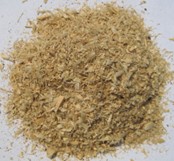
Saw Dust or Wood Shavings
The use of saw dust in growing media has been around for arguably the same amount of time as growing media (soilless substrate). Saw dust is consistently produced from sawmills that have existed across most locations for hundreds of years, making the material one of the most widely available.
Sawdust isn’t quite the same as wood fiber as it is not engineered, so to speak, and there are several challenges with using it as a growing media component. Since sawdust is not processed with the intention of being used in growing media, it typically does not have an optimal particle size and its quality varies widely depending on the lumber mill, the tree species they are utilizing and what they are producing.
Particle size often fell into a range of 2 to 15mm and would be incorporated by up to 30% of a mix by volume. In addition to sawdust’s inconsistency, it is prone to significant nitrogen immobilization. As a result, sawdust is not commonly used in professional mixes.
Whole Tree/Chip Substrate
Wood substrate for more professional mixes was developed in North America in the early 2000s. Pine tree substrate (PTS) is wood material from pine species that has been processed through a hammer mill. This material was also referred to as Clean Chip Residual (CCR), WoodGro and Wholetree.
PTS is derived from grinding tree trunks and branches, including the bark. PTS falling into a certain particle size distribution has been patented and trademarked with the name WoodGro®. This material was developed by researchers primarily at Virginia Tech University.
Whole Pine Tree Substrate, or WholeTree, is a material that utilizes all the parts of the pine tree, including bark, cones and needles. Researchers at USDA/ ARS in Poplarville, MS developed this substrate to evaluate this method of using pine trees. The primary idea is that smaller pine trees usually discarded in the thinning process of managing forest tree stands are suited to this purpose. There were, however, some challenges that had to be considered with this material.
Challenges with Early Wood Substrates
Phytotoxins
Improperly aged hammermilled material and sawdust material are prone to carrying phytotoxic compounds from the tree, such as polyphenols, resin acids and tannins. These are compounds that trees naturally produce as a defense mechanism.
In order to reduce these compounds to non-phytotoxic levels, many producers will age the tree material for 60 days, although studies have shown that 4 to 6 weeks is typically enough time to remove most phytotoxins, depending on the wood source. The aging process allows the wood to be partially broken down by natural microorganisms, which also produce heat. This process releases many of the phytotoxins and brings them down to a concentration that will not retard plant growth.
Nitrogen Drawdown
Nitrogen immobilization is the technical term that is often referred to as nitrogen draft, nitrogen tie-up, nitrogen drawdown, etc. This is somewhat of a two-fold phenomenon, in which wood material will actually bind or fix N in the form of ammonium N on negatively charged sites on the wood surfaces.
The other aspect is that microorganisms use available carbon (C) from the bark or wood to grow. Microbes need nitrogen to grow as well. Stimulating microbial growth with carbon forces a need to feed microbes’ nitrogen; microorganisms are very efficient at obtaining N. The more carbon available there is, the more nitrogen you need to satisfy the growth of microorganisms.
The source of the wood (tree species, tree age, parts used), the period following harvest and the particle size—including the shape/geometry of the particles (as affected by the chipping or shredding process) and C/N ratio—plays a significant role in the availability of carbon microbial growth.
Generally speaking, bark has a lower C/N ratio than wood or sawdust, sometimes referred to as “white wood.” So as you can see, it gets a little tricky when it comes to determining nitrogen requirements with non-aged hammermilled wood.
This gave way to wood fibers with a more engineered approach to overcome inconsistency, significant nitrogen immobilization and phytotoxicity. Segway modern hammer milling, disc refining and screw extrusion!
Engineered Wood Fiber
More engineered wood fiber products were developed to overcome the previous challenges mentioned. These products are notably more uniform, have reduced nitrogen draw back, reduced phytotoxins and are less susceptible to decomposition. Each method produces a growing medium with unique particle size and geometry, and subsequently, its own advantages and disadvantages. The production method for these wood fiber products has been well described by Dr. Brian Jackson in his Greenhouse Management article, “Methods for mitigating toxicity in fresh wood substrates” (2020), which has been quoted here.
Hammer-Milled
“Hammer mills, the cheapest and most common of the methods, are used universally for processing many types of organic materials. Hammer mills operate by pulverizing particles with swinging hammers (or knives) until the material is reduced in size enough to pass through a perforated screen” (Jackson, 2020).
This is the least intensive process for producing engineered wood fiber and tends to have more of the previously mentioned challenges relative to the other engineered wood fibers. Since this method relies purely on physical processing and there is no major increase in temperature or pressure, phytotoxins are not released, if present in the feedstock material. There may be some minimal release of these toxins on the smaller particles after being exposed to the air after processing through volatilization, but it would be minimal.
Hammer-milled wood fiber tends to be coarser and more chip-like compared to the wood fiber produced through disc refining, and therefore can have a more aggregate effect, where it can increase the drainage of the mix. Of course, this depends on the target particle size of the wood fiber as it can be widely modified. Since hammer-milled fibers are not as processed as other wood fibers, the feedstock material and aging play a major role in creating a safe, high-performing wood fiber.
Sun Gro Hammer-Milled Natural Peatland Fiber (NPF)
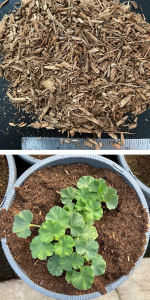
Sun Gro’s Perlite-Free Natural Peatland Fiber mix (NPF) uses hammer-milled wood fiber from the peat bog as an aggregate. NPF material is a combination of woody peatland species that are removed from peat bogs when initially opening and during peat harvest.
These materials would be waste materials and age naturally on the bog for several years to decades. In some cases, this wood material would otherwise be used to help construct rudimentary roads to allow equipment to travel across the bogs. This material, while not as consistent as some other wood fibers, does come with the benefit of being aged for many years and in a relatively sterile environment where low pH, cool conditions and minimal contaminants create a safe material to use.
This wood material is processed through a hammermill and incorporated into a mix more as a true aggregate to replace perlite, than as a peat extender. The natural-looking aggregate is locally produced at the bogs and creates a very cost-effective mix. Sun Gro launched its Natural Peatland Fiber mix back in 2018, and it has been proven commercially in many greenhouse operations.
Disc-Refined
Disc-refined wood fiber is created by the use of two (twin) discs breaking apart wood under pressure.
“The twin-disc refiner is a large disc mill operating at high speed and pressure (+/- 4000 kilopascals = ~580 PSI) with internal temperatures reaching 220 – 400 °F (110 – 200 °C). This technique often has a water bath phase where wood chips are pre-soaked in a pressurized heated vessel for several minutes before being forced through the rotating discs. In this scenario, there is a solubilization and volatilization phase of the process which are effective at removing harmful wood extractives…. The friction heat and pressure effectively volatilize many wood extractives, thus mitigating the phytotoxicity of the end product (substrate) even when used immediately.” (Jackson, 2020).
The first company to commercialize disc-refined wood fiber was Profile Products under the HydraFiber brand. Hydrafiber came onto the scene around 2012 in North America and has grown since.
Disc-refined wood fiber is more of a true fiber than an aggregate, and may be more appropriate as a peat extender in some cases. Disc-refined wood fiber has a similar total porosity to peat moss, but tends to hold less water and provide more drainage and aeration. This has led to a need for some growers to increase irrigation frequency in high-percent disc-refined wood fiber mixes.
Disc-refined wood fiber is typically added to peat-based substrates by up to 30% in preformulated mixes, or incorporated at the grower site using specialized equipment to make custom blends.
Screw-Extruded
Screw-extruded wood fiber is wood chips that have been forced between two rotating screws, causing high heat through friction. Specifically, it involves:
“Twin-screw extruders having opposing screws that apply mechanical energy to wood chips, which crushes, shears and squeezes them to separate the wood fibers. During the process, the pressure can rise to 500 kilopascals (~75 pounds per square inch – PSI) and the temperature can reach 210–230 °F (100–110 °C). After passing through the screws, a sudden “relaxation” of friction and pressure creates a steam explosion, which results in further tearing of the wood fibers.” (Jackson, 2020).
Similar to disc refining, screw extrusion creates a more processed wood fiber that is mostly free of phytotoxins through the pressure and/or heat, which volatizes these compounds from the wood. The end product is different from disc-refined wood fiber. It tends to be chunkier and acts more as an aggregate, falling somewhere in between the physical properties of hammer-milled wood fiber and disc-refined wood fiber. While this method of wood fiber production has been around for several years, its use in commercial growing media has expanded more recently.
All of these production methods can be slightly tweaked in terms of machine settings, feedstock, pressure and equipment to create wood fibers with desired water holding and air capacity. This leads to unique wood fiber growing media, even within one production method. Today, there are over 100 wood fibers produced for commercial applications or research.
Polar Bear® – The Next Generation of Extruded Wood Fiber
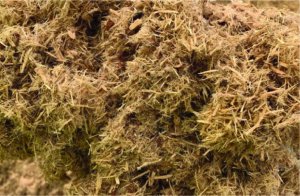
After years of development, Sun Gro has developed the next generation of wood fiber mixes, trademarked Polar Bear®, which is a dual structured wood fiber exclusive to Sun Gro.
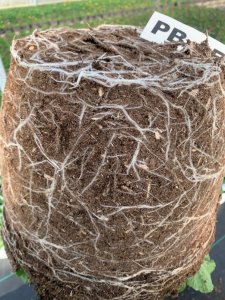
It has been engineered to provide the perfect blend of moisture retentive fibers and chip aggregates for both aeration and drainage.
This unique combination of particles allows Polar Bear® to act both as an aggregate and main substrate component. It improves over other wood fiber mixes by offering a low-dust, excellent flowability alternative that works for a wide range of tray/pot sizes. It also does not require any specialized equipment, making it an easy substitute for growers who use compressed peat-perlite mixes through a bale breaker. Polar Bear® mixes are available in all-purpose and high porosity versions, as well as with or without perlite versions.

Brandon Yep, Grower Specialist, Canada
Got questions? Feel free to reach out to me at [email protected]