

Picture this: you are a peace lily inside the commercial greenhouse of a seasoned grower. Like a spoiled child, you’ve grown up in a world where you’ve received everything you’ve ever wanted— ample water, nutrients, light, warmth, airflow, humidity, a sturdy growing media and protection from pests and disease. But as with all floriculture crops, at some point mom and dad need to make some actual money, and they can’t let you live rent free in the greenhouse. You are now faced with entering the treacherous and unpredictable retail and consumer environment—water may be scarce or suffocating, light may be something you only see on the drive home, and fertilizer… ever heard of it?
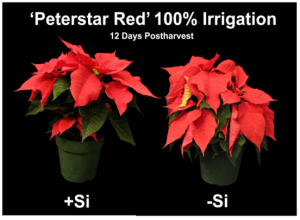
Yes, we all know that once a plant leaves the greenhouse, chances are it will be neglected and most likely suffer some level of drought stress, nutrient deficiency or temperature stress. After a couple of weeks at consumer homes, plants tend to look a bit more disheveled than when they were bought. But what if there was something that could extend that glorious, turgid and healthy appearance that consumer first fell in love with when they bought the plant? Surely that would benefit the grower, as customers begin to notice that “Dave’s Greenhouses” sell the only plants that don’t wilt over time.
Well, as it turns out, there is such a thing. In addition to hardy genetics and hardening techniques using temperature and certain nutrient combinations, supplementing silicon can help keep plants in their greenhouse glory.
Why Silicon Matters in Soilless Production
Silicon is a beneficial nutrient for most plant species—and essential in some. We don’t hear much about silicon in agriculture because most soils are already abundant with it. However, in horticulture soilless production, silicon is mostly absent. It’s a shame silicon is not discussed more in horticulture, because its potential benefits in improving shelf life are remarkable.
Potential Benefits of Silicon for Plant Health
The benefits of silicon are hard to believe, but the major examples include:
- Heavy metal tolerance1,2,3
- Salt stress tolerance4,5
- Drought tolerance6
- Recovery from chilling stress7,8
- Resistance to root rot9
- Resistance to powdery mildew10
How Silicon Supports Plants Under Consumer-Level Stress
You might not notice many of these benefits in the commercial greenhouse setting, due to the luxurious environment provided by expert growers. However, once plants become stressed at the consumer level, silicon can really do its thing.
For example, many home consumers tend to overwater their houseplants. Overwatering leads to a lack of oxygen in the rootzone, causing ideal conditions for pythium or fusarium to thrive. These pathogens cause root rot and ultimately lead to poor plant growth. Silicon has been shown to reduce the severity of root rot caused by pythium in cucumber.9 Silicon can reduce the severity of root rot by limiting the penetration of the pathogen and making it more difficult for it to survive in the root tissue itself.
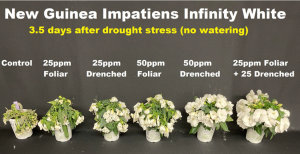
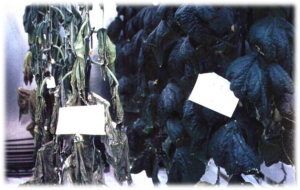
On the other side of the plant torture spectrum, outdoor patio plants or hanging baskets are often underwatered, leading to drought stress. Silicon has the potential to reduce drought stress by keeping more water in the plants, ultimately extending time to wilt and potentially saving the plant from dying. This has been demonstrated in many floriculture species, such as the poinsettia, phlox and gerbera pictured below.
How Silicon Works in Plants
So how is it possible that one element can have so many benefits? Silicon enhances the plant tolerance to stress through multiple mechanisms: physical, chemical and gene activation. The chemical and gene activation mechanisms are fairly complicated; however, the physical mechanism is fairly straightforward and is theorized to be responsible for many of silicon’s benefits.
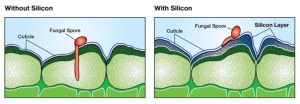
Silicon often accumulates underneath the cuticle (the outermost layer of plants) as silicon dioxide (SiO2·nH2O), which is a silica gel. This gel supports the cuticle in forming a physical barrier, separating the external environment from the water- and nutrient-rich internal tissue of the plant. Under drought conditions, water is pulled through the cuticle even when stomata are closed, as the cuticle is not completely impermeable and water can be pulled out into the dry air. It is largely theorized that, when the cuticle is reinforced with silicon, this barrier helps retain water under drought stress. It is also thought that this physical barrier limits pathogens and pests from penetrating through the cuticle and infecting the plant. Think of silicon in plants acting similarly to silicon caulking used to protect water-exposed areas in kitchens and bathrooms. It protects what’s inside and keeps potential threats out.
But don’t just take our word for it. Gemini, Chat GPT and other AI or large language models can provide additional scientific links and summaries to the benefits silicon can provide for plants. And if you’re looking to dive even deeper, people have written entire books on the benefits of silicon in plants! (Silicon in Agriculture: From Theory to Practice | Springer Nature Link (formerly SpringerLink)
How can you add silicon to greenhouse crops?
There are a couple of ways to add silicon to plants, which include:
- Foliar application
- Root drench / irrigation application
- Incorporated into growing media
Silicon is typically provided in the form of:
- Potassium silicate (K2O3Si)
- Sodium silicate (Na2SiO3)
- Calcium silicate (Ca2O4Si)
- Aluminosilicates (found in soil) (Al2SiO5)
- Mono-silicic acid (H4SiO4)
There is a caveat to silicon benefits. Silicon needs to be consistently available to the plant. This means foliar and root drench applications need to be repeated. Alternatively, if silicon is provided as a slow-release nutrient in the growing media, no applications are needed.
RESiLIENCE®: Silicon Already in the Mix
Sun Gro adds silicon into all of its standard mixes through its patented silicon additive à RESiLIENCE. There is no additional cost to RESiLIENCE and does not require any changes to watering or fertilizer program compared to other standard growing mediums. RESiLIENCE releases silicon overtime (multiple months) allowing for silicon benefits without any application.
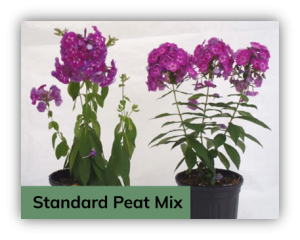
8 days after last watering
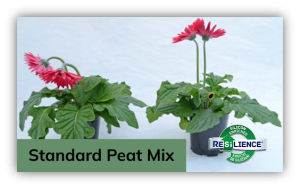
4 days after last watering
In conclusion, silicon acts like a form of plant health insurance that can have profound benefits on plant quality after it leaves the greenhouse.
If you have questions, feel free to reach out [email protected] or any of the other Sun Gro Grower Specialists!

Grower Specialist, Canada
References:
1 Flora, Christopher, Sushant Khandekar, Jennifer Boldt, and Scott Leisner. “Silicon Alleviates Long-Term Copper Toxicity and Influences Gene Expression in Nicotiana Tabacum.” Journal of Plant Nutrition 42, no. 8 (May 9, 2019): 864–78. https://doi.org/10.1080/01904167.2019.1589508.
2 Frantz, Jonathan M., Sushant Khandekar, and Scott Leisner. “Silicon Differentially Influences Copper Toxicity Response in Silicon-Accumulator and Non-Accumulator Species.” Journal of the American Society for Horticultural Science 136, no. 5 (September 2011): 329–38. https://doi.org/10.21273/JASHS.136.5.329.
3 Luyckx, Marie, Jean-François Hausman, Mathilde Blanquet, Gea Guerriero, and Stanley Lutts. “Silicon Reduces Cadmium Absorption and Increases Root-to-Shoot Translocation without Impacting Growth in Young Plants of Hemp (Cannabis Sativa L.) on a Short-Term Basis.” Environmental Science and Pollution Research 28, no. 28 (July 2021): 37963–77. https://doi.org/10.1007/s11356-021-12912-y.
4 Berni, Roberto, Rushil Mandlik, Jean‐Francois Hausman, and Gea Guerriero. “Silicon‐induced Mitigatory Effects in Salt‐stressed Hemp Leaves.” Physiologia Plantarum 171, no. 4 (April 2021): 476–82. https://doi.org/10.1111/ppl.13097.
5 Epstein, E., and Bloom, A.J., 2004. Mineral Nutrition of Plants: Principles and Perspectives, second edition. Sinauer.
6 Mattson, Neil S., and W. Roland Leatherwood. “Potassium Silicate Drenches Increase Leaf Silicon Content and Affect Morphological Traits of Several Floriculture Crops Grown in a Peat-Based Substrate.” HortScience 45, no. 1 (January 2010): 43–47. https://doi.org/10.21273/HORTSCI.45.1.43.
7 Li, Yuan, Joseph Heckman, Andrew Wyenandt, Neil Mattson, Edward Durner, and A.J. Both. “Potential Benefits of Silicon Nutrition to Hydroponically Grown Sweet Basil.” HortScience 55, no. 11 (November 2020): 1799–1803. https://doi.org/10.21273/HORTSCI15320-20.
8 Ly, Vivian & Zheng, Youbin. “Alleviation of Chilling Injury in Postharvest Sweet Basil (Ocimum basilicum L.) with Silicon and Abscisic Acid Applications.” Agriculture. 15. (2025): 643 10.3390/agriculture15060643.
9 Chérif, M., J.G. Menzies, D.L. Ehret, C. Bogdanoff, and R.R. Bélanger. “Yield of Cucumber Infected with Pythium Aphanidermatum When Grown with Soluble Silicon.” HortScience 29, no. 8 (August 1994): 896–97. https://doi.org/10.21273/HORTSCI.29.8.896.
10 Frantz, Jonathan M, and James C. Locke. “Ready Research Results: Silicon In Floriculture Fertility Programs.” Floriculture Research Alliance, Production Special Series, n.d.
11 Wang M, Gao L, Dong S, Sun Y, Shen Q and Guo S (2017) Role of Silicon on Plant–Pathogen Interactions. Front. Plant Sci. 8:701. doi: 10.3389/fpls.2017.00701