

Most growers are very familiar with peat moss. Whether they recognize it as peat moss or as “soil”, growers have a lot of experience with the material, given it is the main component of most potting mixes. They can notice differences in the texture, the fibers, smell and overall quality. But few are familiar with how peat moss actually gets into their greenhouse. From remote, northern areas of Canada, peat moss has an interesting journey from bog to bag, that involves expertise from resource managers, harvesters, plant operators and restoration teams. Read on to learn how the most important growing media component gets to your greenhouse.
Removing the Vegetation
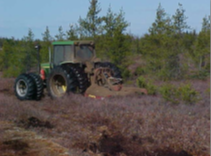
It all starts with peatbogs located in regions across Canada. Most active peat harvesting bogs are found in Quebec, New Brunswick, Manitoba and Alberta. Bogs are home to not just peat, but also many unique plants adapted to highly-acidic, water-saturated conditions such as black spruce, tamarack, common labrador tea, bog cranberry, cloudberry, and blueberries. Before being able to harvest peat moss, the top layer of vegetation on the bog needs to be removed to gain access to the layers of peat moss underneath. First, any large trees and shrubs are removed, and the smaller vegetation is mowed or broken up using a mulcher and/or mericrusher. The vegetation removed from the bog can be used as “donor material” for bogs that are being restored nearby, in order to bring back native peatland species.
Lowering the Water Table
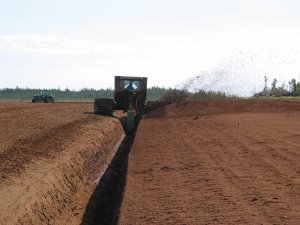
Since bogs are saturated with water, the first step is to lower the water table of the bog. This is done by creating drainage ditches along the borders of the designated peat harvesting area. These ditches are 2 m (6.5 ft) deep and created using a ditch digger attachment on the back of a tractor. These ditches are referred to as perimeter drainage ditches and are continuously lowered as peat is harvested. Next, shallow ditches are dug parallel to one another within the area of the perimeter ditches. The shallow ditches connect to the perimeter ditches to help speed up the drainage of water from the bog. These ditches are referred to as field or lateral drainage ditches. The ditches run parallel to one another, approximately 30 m apart. The drainage system will lower the water table by approximately 1 m, allowing the peat to eventually dry down to a target moisture content of 40 to 55%.
Levelling the Bog
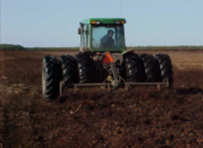
The bog is then tilled multiple times using equipment such as rotary harrows. A profiler is also used to create a convex shape on the bench (the area between lateral ditches) to improve water drainage between lateral ditches. At this time, large sticks, rocks, and other large natural debris are removed from the bog using a root picker. This allows peat to be harvested more efficiently and consistently.
Exposing the Peat
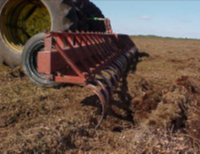
At this point, the peat is sitting fairly level on the ground. In order to increase the speed at which peat is dried, a greater surface area of the peat needs to be exposed to the air and sun. This is achieved by harrowing the bog, which creates rows of small mounds on the bench that increase the surface area of exposed peat to the air.
Harvesting the Peat
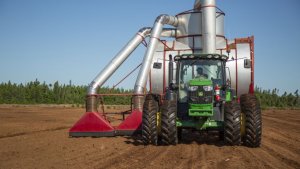
Once the bog has been exposed to a few days of consistent dry weather (can vary depending on sun and wind), the peat will be dry enough to harvest, typically having a moisture content between 40 and 55%. Vacuum harvesters are then brought out into the field and extract up to 1 – 2 cm of peat in depth at a time. A single vacuum harvester can harvest over 100 acres per day. There are typically only 40 – 50 suitable days a year in which peat can be harvested. This window is typically between May and October depending on the location of the bog.
Storing and Transporting
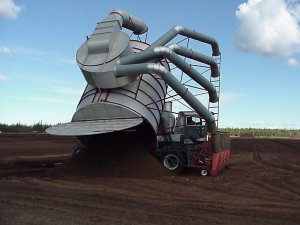
After peat is harvested, it is unloaded in 10 ft tall piles called windrows. Loaders then fill up trailers that haul the peat to processing plants that can range from 1 to 300 km away depending on the location of the bog.
Processing
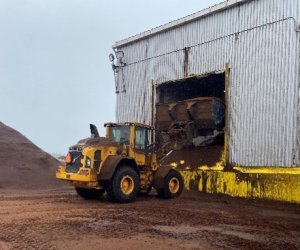
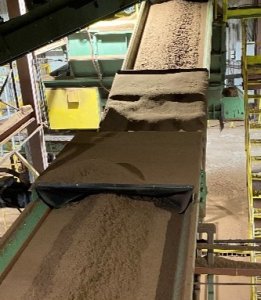
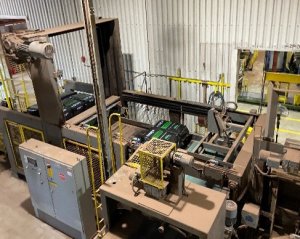
Peat from different bogs is mixed and screened multiple times to create different grades of peat. Specific grades of peat are mixed with other raw materials such as perlite, bark, fertilizer, wetting agent and lime through hoppers and augers, to create a complete potting mix. Mixes are packaged into various compressed (110, 55, 3.8 cfc) or loose fill formats (2.8, 80 cfl.), labelled & palletized.
Restoration
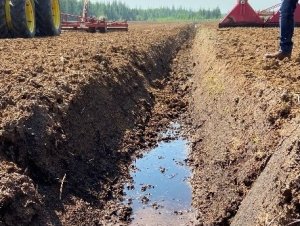
Once harvesting has ceased, restoration activities occur to help return the natural hydrological processes and to re-establish peatland vegetation. First, depending on the conditions of the bog, drainage ditches are blocked or blocked and filled, allowing water levels to rise, helping create an ecosystem conducive to peat accumulation. At the same time, fields are re-profiled and modified to create substrate conditions that retain water and are suitable for the establishment of peatland species. These activities allow the natural hydrology of the peatland to return after one to two years.
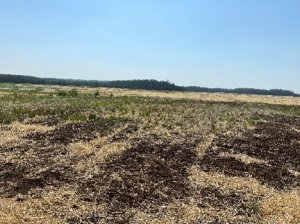
Revegetation will begin after rewetting, reprofiling, and surface preparation are complete to ensure that conditions are favorable for the regeneration of introduced propagules. This is accomplished through the re-introduction of peatland plant species (donor material), a method known as the moss layer transfer technique. Plant material from nearby natural bogs is spread across the harvested peatland at a ratio of 1:10 (1 m2 of donor material to restore 10 m2), with a depth of approximately 1 cm. Straw is applied as a mulch to shelter the plant material and increase moisture. Fertilizer can be applied to help vegetation to establish more rapidly.
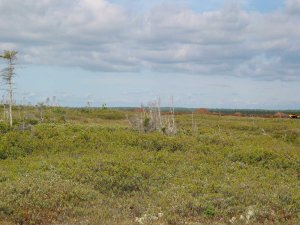
Following restoration operations, the bog is closely monitored over the following decades to determine the success of restoration. Sphagnum-dominated plant cover is typically re-established within approximately 5 to 10 years following restoration. Within 15 years post-restoration, peatlands are able to capture carbon at the equivalent levels of natural peatlands. Since 1996 Sun Gro has contributed more than $3.1 M in-kind finances to research optimizing peatland restoration methods.
Contributors: Cassandra Brown, Laura Hjartarson, Warren Walker and Brandon Yep.
If you have questions, feel free to reach out [email protected] or any of the other Sun Gro Grower Specialists!

Grower Specialist, Canada