

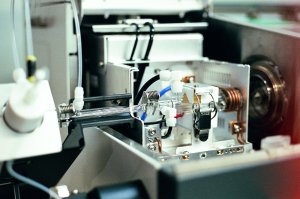
Photo by: ICP atomizer – creative commons
The unintended introduction of heavy metals into the production environment poses a hazardous and potentially costly risk for growers producing medicinal and edible crops. To safeguard these crops and consumers alike, it is critical that growers understand potential strategies for screening and remediating heavy metals from the production environment. Measuring heavy metals using methods that provide a meaningful representation of plant availability is an essential part of the screening process and will help guide decision making when growers need to implement remediation techniques. In part two of our Heavy Metals in Horticulture series, we will examine different lab testing methods for measuring heavy metals, when to use them, and what remediation techniques growers can use to help mitigate the risk of heavy metal uptake if a contamination event occurs.
Measuring and Screening for Heavy Metals
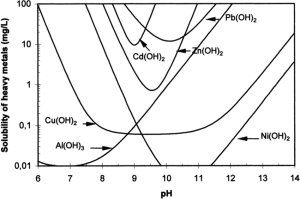
Image by Yeo et al., 2024: Solubility curves of common heavy metal hydroxides as a function of pH (reproduced from Chimenos et al., 2000).
Microwave-assisted acid digestions (as outlined in EPA method 3050B and 3051A) tend to be the standard laboratory procedure that growers and regulators use to measure heavy metal concentrations in a given sample, because it provides consistent recovery of metals and is widely accepted by regulatory agencies and testing labs. In this procedure, a dried and ground tissue sample is placed in a sealed digestion vessel with concentrated acids, typically nitric acid and/or hydrochloric acid, and is heated under pressure in a microwave digestion system to about 180-200°C (356-392°F) until the sample has been completely liquified. This process breaks down all organic material and releases heavy metals such as cadmium (Cd), arsenic (As), and lead (Pb) into solution, where the resulting digest is then analyzed using instruments such as ICP-MS or ICP-OES to determine the total amount of each metal present in the sample.
While microwave digestions work well for measuring heavy metals within materials with high bioavailability such as plant tissues, fertilizers, and composts, it is generally not suitable for field soils and soilless substrates. The reason is that the digestion process is an intentionally aggressive procedure designed to extract 100% of the heavy metals present within a sample, which means it dissolves not only the metals that roots can access, but also the metals that are tightly bound to substrate components that would normally be unavailable for plant uptake. To put it another way, you wouldn’t liquify your peat moss before you grow plants in it! As a result, when digestions are used to measure heavy metals in substrate, they tend to overestimate the plant available fraction. Recent studies on greenhouse substrates have emphasized that plant availability of heavy metals is better estimated using mild extraction methods that simulate root-zone conditions, such as water extractions, salt extractions, or extractions that use chelating agents such as DTPA.
Remediation Techniques
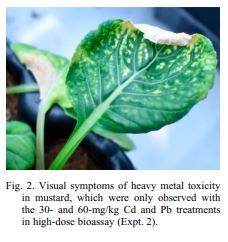
Image by Meekins et al., 2025: Heavy metal toxicity symptoms in mustard (chlorosis, necrosis, stunted growth, and reduced yield).
Maintaining proper root zone pH is one of the easiest and most effective ways growers can reduce the chances of heavy metal uptake. Heavy metal solubility is highly influenced by substrate pH, with metals such as Pb becoming more soluble and easier for roots to absorb as substrate conditions become more acidic. In greenhouses and other highly controlled environments, regular monitoring of substrate pH can help keep metals in less available forms thereby reducing the risk of accumulation in economically important plant tissues such as flowers or foliage and can be seamlessly integrated into existing fertility monitoring and management programs. For cannabis, brassicas, or other high value crops that are prone to hyperaccumulating heavy metals, maintaining crop-specific pH targets closer to 6.0 is often a simple and cost-effective risk management tool, because it addresses metal availability directly at the root surface rather than trying to correct the problem after uptake has occurred. Recent studies of heavy metal management in plant production systems consistently identify pH as one of the key factors controlling metal mobility and availability in the rhizosphere.
The use of biochar has received considerable attention as a substrate component that can reduce heavy metal uptake in crop production systems. Because biochar is a carbon-rich material with a substantial amount of surface area, it can significantly increase substrate cation exchange capacity (CEC) which ultimately leads to the increased adsorption of heavy metals, making them less available for plant uptake. Biochar can also increase substrate pH and buffering capacity, which helps maintain root zone pH levels that reduce the solubility of heavy metals and therefore reduces the potential for plants to absorb them. For commercial greenhouse and CEA operations, incorporating a high-quality biochar into the substrate may help reduce the transfer of heavy metal contaminants into crops while also providing benefits for improved water and nutrient retention.
Silicon nutrition and silicon-based amendments are also emerging as a promising tool for managing the risks of heavy metal uptake. Unlike biochar, which primarily works by influencing sorption and pH dynamics within the root zone, silicon can influence both the substrate and the plant itself. Studies have shown that silicon can improve heavy metal tolerance in plants by reducing the movement of metals from roots into shoots, strengthening cell walls, and promoting the sequestration of metals in root tissues where they are less likely to affect marketable portions of the plant. In greenhouse and CEA settings, incorporating products like calcium silicate can be a very cost-effective option for mitigating heavy metal uptake, because it can stimulate heavy metal tolerance within the plant while simultaneously increasing substrate pH and reducing metal solubility. Silicon as a substrate amendment may be particularly useful when growers are dealing with low to moderate contamination levels and want to reduce the risk of metal accumulation without negatively impacting crop growth or yield.
One of the most important management practices for avoiding heavy metal contamination is avoiding excessive fertilization, particularly with products high in phosphorus or when plants are at a point in their life cycle where they are especially susceptible to contamination. Recent research suggests that phosphate ions can act as a carrier for heavy metals such as Cd, which means excessive phosphate applications could enhance plant uptake of heavy metals. This is especially relevant for cannabis production where many feeding programs have promoted the use of high phosphorus “bloom boosters” during flower development despite limited scientific evidence that elevated phosphorus levels improve yield, cannabinoid production, or terpene content. For cannabis in particular, excessive phosphorus applications during flower development can also exacerbate heavy metal contamination because this is when the plant is most susceptible to translocation of heavy metals into floral tissues. A balanced fertility program that avoids excessive nutrient levels not only reduces the risk of marketable plant tissues absorbing trace metals but also helps maintain a more stable root zone environment that is less conducive to heavy metal uptake. Commercial growers can reduce both nutrient waste and the potential for heavy metal contamination by aligning fertilizer applications with crop demand, rather than relying on aggressive “bloom-feeding” strategies.
Conclusion
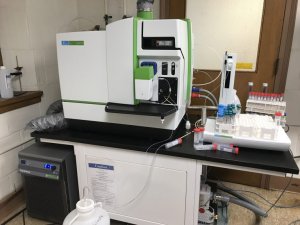
Image of ICP‑MS instrument used to measure trace metals.
Screening for heavy metals requires robust procedures, and a strong understanding of how to appropriately measure each input. Not all testing methods provide the same information, and choosing the right test is critical for making informed decisions. Complete digestion methods that use heat and strong acids are often the best choice for screening inputs that have high bioavailability, because they measure the total amount of heavy metals present within a given material. For other inputs that are more stable and will not rapidly decompose over the duration of a crop cycle, such as field soils or substrates, extraction methods that better reflect root-zone dynamics can provide more meaningful estimates of the metals available for plant uptake. When potential risks have been identified, growers can use proven management practices such as maintaining proper root zone pH, incorporating biochar and/or silicon, and avoiding excessive fertilization to help reduce the chances of heavy metal uptake. By combining appropriate testing with practical remediation techniques, growers give themselves the best chance to protect crop quality, maintain regulatory compliance, and reduce the risk of costly crop losses.