
Sun Gro’er Blog

Why CEA Is Poised to Lead the Transparency Conversation

Heavy metals are often found in field soils, but, even in tightly controlled greenhouses and vertical farms, these elements can enter the growing space. They do so through substrate materials (coco coir, perlite, and peat), irrigation water, and recycled inputs. Because CEA systems are enclosed, inputs can be closely monitored and controlled.

CEA does not guarantee clean inputs by default. But it does give growers the tools and control they need to find and fix problems that traditional agriculture cannot detect. That distinction matters to the consumers who are paying attention.

Understanding Food Traceability and Input Requirements

Grocery stores have started tightening supplier requirements around traceability and input documentation. Major retailers are increasingly requiring suppliers to document not just what they grow, but how they grow it.

Alongside retailer requirements, the Food Safety Modernization Act (FSMA) adds another layer of pressure. Section 204D specifically focuses on improving traceability and responding quickly to food contamination. There are 24 foods on the Food and Drug Administration’s (FDA) Food Traceability List that requires manufacturers, processors, and packers to keep additional documentation.

Cucumbers, leafy greens, herbs, peppers, tomatoes, and strawberries—all key CEA crops—are included in the rule. For growers, meeting these requirements starts with the inputs themselves.

Here’s what documentation looks like in practice:

  1. Certificate of Analysis (COA): An official document from a third party that confirms that food products, substrates, and water meet quality, safety, and regulatory standards. It verifies heavy metals, microbial counts, and pesticide residues.
  2. Substrate sourcing: For commercial produce growers, all purchased substrates and soil amendments must go through a validated treatment process or must be handled like untreated materials.
  3. Water quality records: Water used to grow, harvest, and pack produce must be documented by produce growers. They should closely monitor and record their water source, use practices, and testing schedules—they should also address any heavy metal contamination that could occur in their water systems.
  4. Pesticide use: Growers must note what pesticide they applied, when, and at what rate.
  5. Chain of custody: Many retailers want to trace a product back through every input. The benefit of a closed-loop CEA system really comes into play here.

CEA growers who build these documentation practices aren’t just staying compliant, they’re building an advantage that field growers can’t match.

How This Affects Growers

For many growers, the bigger question is practical: What does building this documentation actually cost?

The average cost of a COA depends on crop type and what growers are testing for. Tests can range anywhere from $10 to $800 per sample. Here are a few tests growers typically complete:

  • Basic Microbial Screen: Tests for common pathogens like E.Coli, salmonella, and listeria.
  • General Food Safety Screen: Combines microbial testing with checks for yeast, mold, and coliforms.
  • Pesticide/Heavy Metal Panel: Tests for pesticide residues and heavy metal concentrations like lead, cadmium, arsenic, and mercury.
  • Nutritional Analysis: Documents macro and micronutrient content. This test is more about label and compliance claims than food safety.

A few other factors determine total cost as well, including test frequency, rushed lab results, and the accreditation of testing facilities.

These costs add up fast, but as consumers become more aware of where their produce comes from, the cost of not testing can climb even higher.

As retailers crack down on these requirements, suppliers who don’t have proper documentation can easily lose the contracts they have. Some retailers established traceability deadlines in 2025, well ahead of what the FDA requires.

While the official FSMA compliance deadline was pushed back from January 2026 to July 2028, the real deadline has already passed. Retailers are already making decisions based on documentation readiness, meaning growers who wait until 2028 could already be falling behind and losing contracts.

Breaking Down the CEA Advantage

Since CEA inputs are controlled by the grower, they’re much easier to document. Here’s a brief breakdown of how documentation looks for CEA growers specifically.

  • COA: With controlled and consistent inputs, growers can test their produce one time and apply their results repeatedly across growing cycles.
  • Substrate sourcing: CEA growers choose and purchase substrates carefully, making it much easier for them to document treatment history than traditional field growers.
  • Water quality records: Hydroponic and recirculating systems have water source and quality tightly controlled. This makes it easier for CEA growers to identify contamination before it reaches the crop.
  • Pesticide use: CEA growers typically use fewer pesticides than field growers—applications are made in a confined space. This gives growers a clear and well-defined paper trail.
  • Chain of custody: Every input in CEA systems enters through a controlled point, often making end-to-end traceability straightforward.

CEA doesn’t guarantee clean inputs. But it does give growers the tools to prove it, and that’s what buyers are asking for.
Heavy Metals in Horticulture, Part 1: Where Do Heavy Metals Come From?

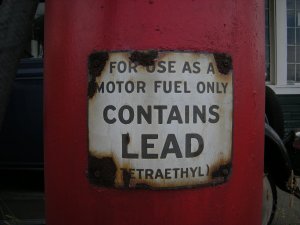
A warning sign on an old leaded gasoline pump

Many edible and medicinal crops are regulated for heavy metal contaminants such as arsenic (As), cadmium (Cd), lead (Pb) and mercury (Hg) because those contaminants pose a serious threat to human health. Crops like cannabis or certain brassica species are known to hyperaccumulate heavy metals within various plant tissues, which can worsen a contamination event when it occurs. Oftentimes, when these contaminants enter a growing system, the first question growers want to answer is where the contaminants came from.

Heavy metals can come from a variety of sources, such as fertilizers, organic amendments and manures, irrigation water, pesticides, growing media or field soils, and atmospheric deposition from anthropogenic activity. In this first article of our two-part Heavy Metals in Horticulture series, we will review potential sources of contamination and the associated risk of each.

Fertilizers

Mineral fertilizers, particularly phosphate-based products, can be a primary source of heavy metal contamination. Certain heavy metals, like cadmium, are naturally occurring in phosphate rocks and may be transferred into the final fertilizer product during manufacturing. Some research suggests that this can be further exacerbated when phosphate ions act as a carrier of Cd, thereby enhancing plant uptake. Arsenic may also be found in mineral fertilizers because it is often a minor component of the sedimentary rocks used for phosphorus extraction. Contaminated fertilizers pose a unique threat to growers because these products are formulated to be readily soluble so that nutrients are easily absorbed by the plant. As a result, heavy metal contaminants may inadvertently become soluble, as well, which ultimately increases the likelihood of plant uptake and contamination. Luckily, heavy metal concentrations within commercially produced synthetic fertilizers are highly regulated, so choosing a reputable manufacturer will minimize the chance of heavy metal contamination.

Heavy metal uptake graphs (bioassay) [Meekins et al, 2025]
Manure-based fertilizers, typically used for organic production, can also be a common source of heavy metal contamination. Metals like arsenic and lead are naturally occurring in field soils where animals graze, and when livestock consumes grain or forage grown in these soils, the metals are concentrated within the animals and excreted as waste. However, contamination of field soils is not the sole culprit of contaminated manure. Many animals around the world are given fortified feeds that contain trace levels of heavy metals that act as antimicrobial agents in the gut and may enhance the overall growth or appearance of the livestock. These fortified feeds usually contain metals like zinc and copper, which are of lesser concern because they are considered plant essential nutrients; however, metals such as arsenic have also historically been included in the diet of livestock. Although many metal-laden feeds are no longer used in the United States, they remain a significant legacy contaminant in older manure piles or in regions with looser regulations, especially because these are elemental contaminants that do not break down over time.

When compared to synthetic fertilizers, heavy metals in manure are generally less immediately available, but can become increasingly more available over time as mineralization and decomposition occurs. Even when heavy metal concentrations in a fertilizer are low, metals can build up and accumulate in the root zone with repeated applications and significantly elevate the risk of contamination.

Irrigation Water

Irrigation water is another common source of heavy metal contamination. Lead can often be found in water because of old and corroded infrastructure such as lead pipes or lead-based solder used to join pipes. Brass components can also pose a potential threat because they sometimes contain small amounts of lead to make them more malleable. Like most micronutrient metals, heavy metals become more soluble as pH decreases, so leaching from lead pipes or brass fittings can be intensified if the pH of your irrigation water is low.

Other types of heavy metals can also be found in contaminated well or pond water, particularly in areas near industrial effluent or a high volume of agricultural runoff. Reclaimed or recycled water can also contain higher concentrations of heavy metals, especially as they accumulate over time. Unlike soil and soilless substrates, where metals might be locked up in complexes with other minerals, metals in irrigation water are often dissolved and in plant-available forms, thereby increasing the risk of direct uptake. Much like fertilizers, even if metal concentrations in water are low, repeated irrigation can cause build up in the root zone. In the case of overhead irrigation, metals can also be applied directly to the foliar and floral tissues, further elevating the chance of heavy metal contamination.

Field Soil, Soilless Substrates and Anthropogenic Activity

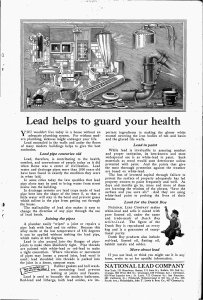
An ad for lead (Pb) from the 1923 issue of National Geographic

Heavy metals are naturally occurring elements that can be found in field soils. These metals are much less mobile in field soils and soilless substrates than in water, in part because of soil chemistry dynamics related to adsorption and metal complexation, thereby reducing the risk of plant uptake.

Cadmium tends to be the most mobile of the four heavy metals because it does not bind strongly to soil particles like clay or organic matter, and it stays readily dissolved in the soil solution where it can easily be absorbed by plants. Arsenic is unique in that its mobility is highly dependent on how saturated the soil is. When soil conditions are saturated and anaerobic, arsenic converts to arsenite, which is highly mobile and toxic. Mercury and lead are generally considered less mobile than cadmium and arsenic. Mercury has a high affinity for organic matter and will lock onto components like peat very tightly and stay put, whereas lead is highly insoluble causing it to precipitate out of solution at pH ranges where plants typically thrive.

Given this information, it is important to note that even if metal concentrations in a substrate are high, the risk of contamination may be lower than other inputs because of the substrate’s ability to “lock up” certain metals via adsorption and complexation, and because substrates are not continuously applied over the course of a crop cycle.

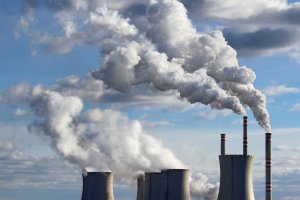
A coal-fired power plant—an example of anthropogenic activity

The predominant driver of contaminated field soils and soilless substrates tends to be anthropogenic activity (caused by humans), particularly the historical use of heavy metal-containing chemicals and pesticides. Factory discharges from burning fossil fuels or dumping of waste materials, mining and urban runoff are all examples of anthropogenic activity that can contribute to elevated heavy metal levels in the soil. In instances where production systems are in close proximity to centers of anthropogenic activity, such as busy roadways or manufacturing facilities, direct deposition of metal-laden particulates onto plant surfaces can also occur.

Before the 1970s, many agricultural chemicals contained components lilead, mercury and arsenic. Lead arsenate was widely used as an insecticide, and methylmercury was commonly used as a seed treatment to prevent rot and fungal disease. Despite the fact that these products have been banned for many decades, the impact is still felt today. Many old orchards and cotton fields still contain high levels of heavy metals to this day, as a direct result of agricultural chemical usage.

Conclusion

The main sources of heavy metal contamination are:

  • Phosphorus-based synthetic fertilizers
  • Organic fertilizers derived from manure or waste products
  • Corroded irrigation
  • Agricultural runoff
  • Direct deposition from industrial processes

Inputs that contain forms of heavy metals that are more plant available, require repeated applications or require application directly to foliar tissues tend to have a higher risk of crop contamination, even if concentrations are relatively low. Other inputs such as field soil or soilless substrates may still contribute to crop contamination but, in general, contain forms of heavy metals that are less plant available. Regardless, heavy metal contamination can come from a wide variety of sources, so it is critical that growers screen their inputs prior to usage to exclude these contaminants from the production environment.

Stay tuned for Part 2, where we will discuss how to measure heavy metals and how to mitigate/remediate them from your growing system.

Harrison Meekins
Grower Specialist, Southeastern US